Tuesday, September 22, 2015

Emotional

Years ago, I was co-teaching a book study.  I think the book was The Jesus I Never Knew. One of the students in the class was very disturbed by the idea that Jesus was fully human in addition to being fully divine.  The same student was certain that Jesus would never be angry - that anger was a sin.

Last night I attended a seminar led by Peter Wallace concerning his book The Passionate Jesus.  His thesis is that God has emotions - all of the emotions that stem from love.  That makes sense if you think about it.  We believe that God feels love; why wouldn't God feel other emotions?  And isn't there evidence for that in the scripture?

Jesus, who was God, and who was God's son, was fully human (and fully divine).  As a fully human person, as a perfect human, he felt emotions.  In his emotions, he teaches us how to live as emotional humans - how to respond appropriately to our emotions.

We are created in the image of God, and our emotions are part of that image.  Isn't that a lovely thought?

Note about image:  One last image from the beach - my buddy, Ray.

Labels: ,

Thursday, May 10, 2007

The Pool and a Miracle

If you’ve read this blog (you three people) very often you may remember that last fall and into the early winter, JtM and I taught a class based on the book The Jesus I Never Knew. One of the most difficult chapters for me to “get comfortable” with was the one about Miracles. I had a lot of questions about that chapter and about the class discussion.

I was browsing the internet the other day, and ran across a blog post, which asked, among things, if miracles still happen today. That was one of the questions that the lesson asked. My answer to that question is yes, but it leads to so many other questions:

Why do miracles happen to some people and not to others?

Read this scripture from John 5: 1-9.

Think about the scene for a minute. Jesus walks into the area around the pool and finds a man there. He knows that this man has been there for a long time – 38 years. He’s not the only person there. “In these (porticoes) lay many invalids – blind, lame and paralyzed.” (verse 3a)

Why did Jesus chose this man to heal? Was it the length of his illness? That seems too simple. Was it that this man was “extra good?” No, because later he advises him to stop sinning. Is this the first person Jesus encountered at the pool? No idea.

The same questions occur to us. If a miracle doesn’t happen, then is it because we didn’t pray enough? Not enough people were praying? We aren’t good enough? Maybe there is a purpose in our suffering?

I just don’t think any of these reasons sound like God. I also hesitate to believe that God is haphazard, so I am left with the idea that God is God, and I am not.

I do think that Jesus performed certain miracles for certain purposes – it gave “proof” of his claims and it gave us examples of what God wants for us – wholeness. It gives us a glimpse of what the future kingdom will be like, and it shows us that God cares about our suffering. Jesus, however, did not come to earth to heal every physical illness, but instead to heal all of our spiritual illnesses.

Does he still do miracles. Yes. When? Whenever, wherever, whatever he chooses. Is it a sign of love? Yes, but not a sign that he loves one more than another.

Then how do I answer these questions? I can’t, but God can.

Labels: , ,

Wednesday, March 21, 2007

The Table is Set

Tonight is the last session of our class The Jesus I Never Knew. At the end of the class tonight, we will have met for fourteen times.

In order to celebrate the community which has been formed among us, the work of God in our midst and any spiritual growth that has been achieved, Jeff the Methodist (who is my team-teacher) and I have planned communion.

Do this in remembrance of me.

The purpose of the class has been to take a long, hard look at Jesus. What have been our misconceptions about him? What can we learn about him? How can that bring us closer to him?

One of the members of our class is a retired minister, and it is an entirely wonderful thing that he has agreed to serve the sacrament. What a blessing.

Do this in remembrance of me.

I've never done this before. I've never "set the table." As the class has been, the communion will be a sharing of the talents that God has given to JtM and me. I've baked bread (and I know I've mentioned before how God has taken simple baking and turned it into a gift). Jeff is bringing the grape juice. He arranged for Fred to serve, and has prepared the liturgy for the class. I've arranged the table. Team teaching has been full of the grace of combined gifts, and it is fitting that the communion is, as well.

Do this in remembrance of me.

When I took the photo of the table, I used the timer on my camera, so that my pushing the "button" wouldn't jar the camera; the shutter would be open a long time since the lights were out. The timer on my camera has a little red light that blinks once per second prior to the shutter opening. The red light reflected on the cross.

Do this in remembrance of me.

Next week we start a new class to examine another of Yancey's books, What's So Amazing About Grace. How wonderful it is to receive a preview tonight.

Images: The table, set. The plate, awaiting bread, and the chalice. Candles lit.

Labels: ,

Monday, March 19, 2007

To feel or suffer with

I'm getting ready to start working on the last lesson of our The Jesus I Never Knew class. Chapter 14 is called "The Difference He Makes." Did Jesus make a difference? Obviously, I would say that the answer is 'yes.' What difference did he make?

One of the six impressions of Jesus that Yancey talks about is that Jesus was a portrait of humanity. I think I might understand this best if I call it a bridge.

First, Jesus was a window for us to finally see God -- before Jesus, God's creation had no real image of who God was. We were meeting in class one week, and one of the tasks we were discussing was to look at the events of Holy Week and try to decide what we could learn about God from each one. One class member said, after reading about Jesus' trial, that she couldn't see God at all in this event. She could not see anything about God. I think the key to this exercise was to realize that if we look at Jesus -- how he acts in various situations, then we can see and understand God. Want to know what God is like? Watch how Jesus behaved. Jesus demonstrates for us God's nature.

In addition, Jesus is a mirror. By looking at Jesus, we can see what humanity was meant to be. In Jesus, humanity is not distorted or degraded by sin. In Jesus, we see man as God created him. If we are made in the image of God, then Jesus reveals what that image should look like.

But, as huge as that is, it that all there is? Where is the other end of the bridge? How did the coming of Jesus to the world affect God? Yancey put to words something that I have felt to be true for a couple of years. Through Jesus, God learns what it is like to be human. Because of Jesus, God learns what pain is like, what temptation is like. Because of that, Jesus becomes our sympathetic advocate. Yancey explains that sympathetic comes from the Greek root words syn pathos -- the feel or suffer with.

Through Jesus, we learn what it means to be human, and God learns what is is like to be human. Through Jesus we understand ourselves, and who we were meant to be. Jesus becomes our advocate to God.

Labels: ,

Thursday, March 08, 2007

Change is Possible

Our son, G, is growing. It seems that every time I turn around, he is taller. The way our stairway is built, there is ceiling at the bottom. Steve, who is 6'4", knows, habitually, to duck when he comes down the stairs. Every once and a while, he will hit his head, but not very often. This morning, G was running down the stairs behind me as we were getting ready to leave the house. I heard a groan, turned around, and found him sitting on the stairs, holding his head in his hands. Apparently, he hit his head on the ceiling as he came down the stairs. He's taller, and he's never had to duck before. Looks like he's going to have to change his habit.

Last night in class we talked about the passage in Matthew 13:24-30 and 36-43 about the wheat and the weeds (or thistles, in the Message). It is a parable which compares the Kingdom of God to wheat seed that a farmer has planted. The wheat grows, but along with it, weeds or thistles sprout up. We talked about what that means, and how it defines the kingdom. One question arose which the parable doesn't really address -- can a thistle become wheat? Can there be a transformation of the very nature of the plant so that, even though it sprouted as a weed, it can, through grace, become wheat? Our conclusion was that, if we were talking about people and not plants, then, yes, transformation is possible.

A case in point.

The Lenten devotion that was sent out today from our church was about Zacchaeus (Luke 19:1-10). In addition, the sermon at our Common Grounds service tonight will be a first person monologue from the tree-dweller, himself. It's a good story. Take just a few moments to read it again.


Then Jesus entered and walked through Jericho. There was a man there, his name Zacchaeus, the head tax man and quite rich. He wanted desperately to see Jesus, but the crowd was in his way—he was a short man and couldn't see over the crowd. So he ran on ahead and climbed up in a sycamore tree so he could see Jesus when he came by.

When Jesus got to the tree, he looked up and said, "Zacchaeus, hurry down. Today is my day to be a guest in your home." Zacchaeus scrambled out of the tree, hardly believing his good luck, delighted to take Jesus home with him. Everyone who saw the incident was indignant and grumped, "What business does he have getting cozy with this crook?"

Zacchaeus just stood there, a little stunned. He stammered apologetically, "Master, I give away half my income to the poor—and if I'm caught cheating, I pay four times the damages."

Jesus said, "Today is salvation day in this home! Here he is: Zacchaeus, son of Abraham! For the Son of Man came to find and restore the lost."
Zacchaeus had been a thistle. He met Jesus, and was transformed into wheat. Change, even though it is not always comfortable, and at times is even hard to fathom, can happen. Transformation is possible. Even from thistles to wheat. Even from tax collectors to faithful disciple. Even from a small boy to a gangly teenager to eventually a man.

Even from who I am to who God created me to become.

Labels: ,

Wednesday, March 07, 2007

Come What May

In our Wednesday Evening class last week, one of those attending asked about the cause of disasters such as Hurricane Katrina. Did we think that God brought about events such as this in order to teach us a lesson? Was this a "knock in the head" to try to point out our sins to us, and to motivate us to change?

Why is it, do you think, that we have a deep need to assign blame, even if the one upon whom we are placing the blame is God? We blame each other, we blame ourselves, we blame God. In reality, there are some events that just happen.

Now there were some present at that time who told Jesus about the Galileans whose blood Pilate had mixed with their sacrifices. Jesus answered, "Do you think that these Galileans were worse sinners than all the other Galileans because they suffered this way? I tell you, no! But unless you repent, you too will all perish. Or those eighteen who died when the tower in Siloam fell on them—do you think they were more guilty than all the others living in Jerusalem? I tell you, no! But unless you repent, you too will all perish." (Matthew 13:1-5)
Accepting that not everything has an explanation, that somethings events just "happen" isn't neat. It doesn't appeal to our sense of order or our sense of fairness. We don't like that. I do think it is better than believing that God sets out to "teach us a lesson" by sending a horrible disaster to a city.

What about the rest of the passage? What about the idea that "unless you repent, you too will all perish."? What is the end result of repentance? Could it be that Jesus is saying that unless we repent, we will die far away from God? That if we repent, we will be closer to God? None of that protects us from disaster, but it does bring us closer to where we need to be, come what may.

Labels: ,

Thursday, March 01, 2007

Risky Love

We were having a discussion in class last night about the Ascension. One of the members of the class said that the sentence in the chapter we were discussing which really struck her was, "By ascending, Jesus took the risk of being forgotten." I knew what she meant -- it was one of the thoughts in Yancey's Ascension chapter which also struck me.

As we talked, another class member said, "Don't you think he (Jesus) knew what would happen? Don't you think he knew how we would react? He's God; he knows things."

Right on the heals of that sentence, another class member said something that I thought was very profound. "Sometimes it's risky to be God."

Sometimes it's risky to be God.

I think that's true. I think it's much more true than the idea that God and Jesus took no risks in leaving us behind. I think it was a risk. I think it could have gone a different way, and we might have forgotten him. Why do I think so?

God is God, and he does "know things." I believe, though, that he has given us free will. We are able to choose one action or another. He set it up that way; it has to be that way. Unless we can choose to love, then we cannot love. Love is not love if it is forced. Love always involves risk, don't you think? There is always a risk of rejection. There is always a risk of being forgotten. It is so very much like the God I have come to know to love us so much as to give us the freedom to love him, too.

Secondly, it is so like us to forget him. We do it all the time. I think that it is much more likely that we would have forgotten him that we would have remembered him. Thank God we have remembered (for it is by grace that we do remember).

It was a risk. It still is. The class member who brought up the idea that the ascension was a risk, also mentioned that it is hard to remember that God is with us. When we are in the valley -- when we are afraid, or lost, or when we feel alone, that it is hard to remember that he is with us. He is God, and he knows things. He knows how hard it can be. That's why he left us each other. That is one of the reasons that we have the Body of Christ, so that we can remind each other.

So that we do not forget.

Image: The image is of the Special Metals building with a Christmas wreath on it. It was taken on Wednesday -- yesterday. I post it because there are a few people who will understand why that makes me happy!

Labels: ,

Tuesday, February 27, 2007

Risk and Consequence

I'm preparing to team-teach a class tomorrow from the Yancey book The Jesus I Never Knew. The topic is the Ascension. I must admit that I've never really thought much about Jesus' ascension. This has been a good chapter to prepare to teach because I've learned so many new things.

Yancey asks the question -- "Why did Jesus have to leave?" Actually, I've never considered that question before. I just assumed that it was part of the plan (and I guess that it was). I've never considered that he might NOT ascend -- might NOT have gone back to heaven, and might have remained here.

I wonder if he disciples believed that he had a choice? If they did, then that would make his departure even more difficult than it was. I like that Yancey explains that by ascending, Jesus was taking a risk -- the risk of being forgotten.

But that's not the only risk. By leaving, he was entrusting us with his mission. I was in a meeting the other day, and one of the students in the class, who is also the chairman of the committee that was meeting, was talking to my team-teacher and me about this chapter. She reached over, swatted JtM on the arm, and said, "Tag, you're it!" By leaving, everything became our responsibility:

And Jesus came and said to them, “All authority in heaven and on earth has been given to me. Go therefore and make disciples of all nations, baptizing them in the name of the Father and of the Son and of the Holy Spirit, and teaching them to obey everything that I have commanded you. And remember, I am with you always, to the end of the age.” Matthew 28:18-20
So what was the consequence of his departure? He left the presence of the disciples, and came to live with them forever. He is part of us; he is within us. We are now the Body of Christ. By leaving, he got closer than he has ever been before, and the world has never been the same.

Image: Drawing by G for youth Lenten devotional

Labels: ,

Monday, February 26, 2007

The Parable of the Fruit Trees

Once upon a time, there were two trees growing in a field. They weren’t planted close to each other, but just close enough that anyone standing next to one could see the other one.

Each tree was rooted deeply in the soil. Each received the grace of sun, rain, wind and birds, so that God cared for each of them, providing them with exactly what they needed.

One tree bore beautiful oranges – round, bright and plump with juice. The other one was heavy with pecans – hard, brown, perfect pecans. Each bore the fruit that he was intended to bear.

God’s children of all ages would come through the field each day, picking oranges. They pealed the luscious fruit, and devoured sections, receiving the blessings of its wonderful juice and sticky sweetness. They would then wander over to the pecan tree, and pick the perfect nuts, telling each other how they would use them in pie, or grind them to flour to make special bread. The needs of God’s children were met to completion by the fruits of the field.

One day, God was walking in his garden. He stopped under the shade of the pecan tree and ran his hand lovingly over its bark. “What is the problem, dear tree?”

The pecan tree, its branching hanging low in dejection, said, “I am not an orange tree. My fruit is ugly compared to those oranges. I am short and not very colorful at all. Are you sure that this is what you made me to be? I keep trying to grow oranges, but I have failed.”

“You are exactly what I made you to be. You bear the fruit that is needed by my children. You are lovely in my sight!”

As God walked away, exploring other parts of his garden, the pecan tree stood straighter, taller, and worked hard to create his perfect nuts.

As the sun sat that day, a very young child wandered into the garden. He stopped by the orange tree, and tried to reach the fruit, but it was all too high for him. He walked over to the pecan tree and slumped against its trunk.

“What is it, little boy?” asked the tree.

“I wanted an orange, but all of the fruit is too high for me to reach.”

“I have pecans. Would you like a pecan?”

“No, I can’t eat pecans. My mother says I am all-er-gic, whatever that means.”

“Oh,” said the tree in sadness.

The little boy’s stomach rumbled. He was clearly very hungry.

Suddenly, the tree felt his very lowest limb begin to tingle. As he watched, a small flower appeared, then faded away, replaced by a tiny fruit. The fruit continued to grow, until a plump, red apple appeared, so large that it pulled on the branch, weighing it down. The little boy’s eyes grew excited and huge as he eyed the delicious looking fruit. “Can I have that?”

The tree said, puzzled, “Of course you can. I think that it must be meant for you.” The young boy reached up, plucked the fruit from the branch, and bit into it. His eyes closed in appreciation as he was fed.

We are God’s creation. He will provide us with every grace we need to do his will. We should never worry about what gift we do not have. We should only focus on using the gifts that we have been given to their greatest potential. In the end, God is in control, and he will give us what we need to feed his children, even when we cannot imagine how his will might be accomplished. He loves us, and we are lovely in his sight.

Labels: ,

Monday, January 15, 2007

Water into Wine

You may have noticed that the graphic I loaded with yesterday’s post was six clay jars. One of the weird-nesses I have found with using Blogger – especially in the last six months or so – is that in order use Blogger’s servers to store my images, I have to load them prior to typing any words in the post. If I type first, then the image pretends to load, but never appears. Why is that? Does anybody know?

Anyway, so I had intended to write about John 2:1-11 yesterday, which is the description of Jesus turning water into wine at the wedding in Cana. I loaded the image, and then just stared at the screen. Nothing. Nada. Not a single thought. I can only sit with the computer on my lap for so long before I decide that the topic will have to wait for another day. I liked the image, though, so I left it.

This morning I spent some time re-reading the Miracles chapter of The Jesus I Never Knew for class this week. Maybe now I have my thoughts in order enough to write this post.

I was reading a post by the Cheesehead in Paradise, a Presbyterian minister, who called the incarnation of Christ “the great do-over” – our second chance. I kind of like that metaphor. Joe preached about this miracle yesterday, and he called it “Out with the old and in with the new.” He compared the water in the clay jars, which was to be used for ceremonial cleaning to the Old Testament laws and ritual. Jesus, by turning water into wine, changed the burden on the laws into the new covenant, symbolized by the wine of communion – the blood of Christ.

It’s good symbolism. Yancey used it as well, except he equated the wine with celebration. I think I may like that, too. Jesus changed the heavy burden of the laws and rituals to a celebration – JOY. There is now JOY to be found in our relationship with God through Jesus. It’s the great do-over. It’s the coming of Grace.

The question which always occurs to me when I read this passage, is why Jesus changes his mind. At first he tells his mother, in effect, not now. It’s not his time, and she doesn’t need to be concerned with the wine at the wedding banquet. And yet, he performs the miracle. Why is that? Why does he change his mind. Yancey says that this was the first, but surely not the last time in Jesus’ public life that “he changed his plans to accommodate someone else.” Is it as simple as that? She asked him to do it, so he changed his plans, and did it?

This action was not just running down to the nearest WalMart and restocking the pantry with extra wine. This action would reveal Jesus to his disciples and to the servants who helped him. Surely rumors of the miracle would leak out? This was the launch of a series of events which would eventually lead to crucifixion. Did he change his plans just because she asked him to?

It does illustrate to us a particular point, however. How often are we so set in our ways and dug deep down in our own plans that we fail to hear God speaking to us? Do we recognize that sometimes God’s guidance comes to us from other people? Do we even notice that the words or advice coming from someone else might be God’s leading?

And then there’s Mary (thanks to Jeff for pointing this out). She just hands Jesus her concern. She has faith that he can do something to fix the problem – she never questions that he CAN. She just hands him the problem and walks away. She doesn’t question him, she doesn’t come back and check on him. She surrenders what is wrong and never picks it up again. Do we do that? No, not usually.

It’s the great do-over. The difference is that this time, we have grace. This time, God is only waiting for us to listen – to trust and obey.

Image: From Hermanolean, as was yesterday's image.

Labels:

Tuesday, January 09, 2007

God touches

There is a concept in the Grace chapter of Yancey's book -- the one I discussion yesterday -- that I really like. The Jews in the time of Jesus were very afraid of becoming unclean. By following the ritual food laws, by maintaining their distance from those they considered to be untouchable (as I talked about yesterday), they were attempting to make themselves acceptable to God.

What was interesting to me was that the way in which Yancey described that Jesus turned this concept upside down. When Jesus touched a person with leprosy, that person was healed instead of Jesus becoming unclean. When Jesus touched the dead body, instead of becoming unclean, Jesus resurrected the body. Yancey quotes Walter Wink, who said, "the contagion of holiness overcomes the contagion of uncleanness."

I read a post today by Brian Russell, who defines holiness as "refecting the character of God." The journey to holiness is transformational. God touches us and changes us.

Isn't that an interesting and important difference? The Jews of Jesus day were attempting to become acceptable to God by what they could do. On this side of the cross, Jesus touches us, God touches us, and transforms us into a holy people, acceptable to God.

Labels:

Monday, January 08, 2007

The Beauty of Grace

I've mentioned before that I'm team teaching a class based on the book The Jesus I Never Knew by Philip Yancey. We've had a break over Christmas, but we start back up again this Wednesday. As part of the preparation for teaching, I re-read the chapter that we will be discussing; I did that today for chapter 8, which is called Mission: A Revolution of Grace.

As I read the chapter, I was struck by how much it sounds like the Beatitudes chapter that I talked about in the post linked here. One of the premises of that post, which discussed chapter 6 in the book, was that the Beatitudes are a reversal of what we would expect from life in general -- that life in Christ is backwards. I came to the conclusion, as I looked at the Beatitudes, that they are ultimately about grace.

It is interesting to me that this chapter about grace reminds me of the Beatitudes. According to Yancey, "grace introduces a world of new logic. Because God loves the poor, the suffering, the persecuted, so should we. Because God sees no undesirables, neither should we. By his own example, Jesus challenged us to look at the world through what Irenaeus would call "grace-healed eyes."

I am reminded of the song by Relient K -- Be My Escape, which has the line, "the beauty of grace is that it makes life unfair." Who do we consider to be "untouchable?" Who do we think are the "undesirables?"

We have a church service on Thursday nights called Common Grounds. It is attended by the poor, the addicted, the lost, and the hungry. I think there are many who would consider this congregation to be composed of the "undesirables" of our city.

I was struck by a sentence in this chapter -- we are "brought back to common ground, as sinners equally desperate in our need of God." What is our common ground -- it is that we are all sinners, and that none of us is considered untouchable, undesirable, or unlovable by God. Grace makes life unfair, and we should thank God for it.

So what do we do to allow God to work through us to bring grace to those around us? I think it is important that we realize that we all matter to God. Sometimes we have trouble believing it of ourselves. Sometimes I think we have trouble believing it of other people, like those who attend Common Grounds.

We need to offer our best. We need to give of all of our gifts to the Body of Christ -- surrendering them all to God's use. We need to remember that we are blessed by God, and because of that, we are able to be a blessing. That's grace. That's the reversal. It is in loving that we becoming lovable. It is in forgiving that we find forgiveness. It is in the act of following God that we find Him.

Image: Tree at VA, converted to grayscale

Labels:

Thursday, November 30, 2006

Community Prayer

Community prayer – it’s what’s on my mind this morning. What is the role of the person who prays for a group of people? What is the role of the minister who delivers a morning prayer in a worship service? Or of the teacher who prays before a class starts? Or of the person who is saying grace at a holiday meal? Beyond that question, is there a right way and a wrong way to do it?

These thoughts were put into motion last night at our Yancey class during a discussion of prayer stemming from the Sermon on the Mount. One of the ladies in the group said, “I don’t like it when people read prayers instead of just praying them” (I’m paraphrasing). I opened myself up when I answered, “I read prayers often.” She went on to tell me why she thought that was not the way to pray, and ended her list with, “They’re beautiful, but are you trying to impress us? You should be talking to God, not to us.” (I’m still paraphrasing).

Those questions stuck with me. They went home with me, they nagged at me, and they ended up being the focus of my morning prayer time.

To understand this post, you’ll need to know my process for preparing a community prayer. If I know I’m praying for a group of people, I will sit down, think, and write a prayer. I then, when the time comes, pray the prayer from what I have written. I can do it from short notes – words to remind me what I want to say – but I still have to, when I write the notes, in my mind, “think” out the prayer. I usually just end up writing in down in full text because it’s quicker.

What is my role when I stand and pray for a group?

I have to believe that that role is two-fold. First, I am serving as a spokesman for the group. I am standing for them, in front of God, offering the group’s concerns and worries to God. This is not me praying for me, usually, it’s me lifting to God the concerns of entire group. (Sidenote: The obvious exception I can see to that is when a person delivering a sermon prays prior to speaking. That prayer is often from the heart of the speaker to God. We, as the community, pray with him/her as a way of affirming our support for the one about to deliver the sermon. “You are not alone; we stand with you as you ask for God’s help.”)

Secondly, if we believe that prayer is two-way communication, then my role is also to communicate to the community, in the prayer, what God wants them to hear. If I do it right – if I am open to it – then God can take that opportunity to speak to the group through what I say.

Speaking for the group, and even more so, being a way for God to speak TO the group are heavy responsibilities.

How does preparation enter into that equation, and is it OK to write things down? Am I doing something wrong when I pray from a written prayer?

If I believe that when God gives me a job to do, that he will work with me to accomplish that job (and after this past year, I believe it), then I also believe that the time I spend in preparation for a community prayer is one of the times when he and I work on what the prayer will be. It is the time when he helps me to discern what concerns the group needs to have raised, and what words from Him that he wants the community to hear. I write it down because, if he spends all of this effort sitting down with me to plan it, I don’t want to miss any of it. I want it to be what he wants it to be, and writing it down is the best way I know for me to accomplish that.

Do I want it to sound nice? Yes, I do, but I hope that isn’t the overriding factor in what I’m doing. Do I write them down, and then pray the prayers to impress anyone in the room? I’m going to give myself a break on this one, and say no. I don’t think I am. It’s something to watch for – a danger, but I hope it’s not my motivation.

Will it always be this way?

Probably not. I’m just starting to develop “prayer muscles,” and I think God has me in Prayer 101. I’m OK with that – in fact I’m enjoying it.

My team teacher opened the class with prayer last night. You can hear God’s echoes in his words. I don’t know if he prepares for those prayers ahead of time, or it God works with him on the spot, but it’s a beautiful gift. Maybe someday I’ll get there.

But for now, God and I are doing it this way.

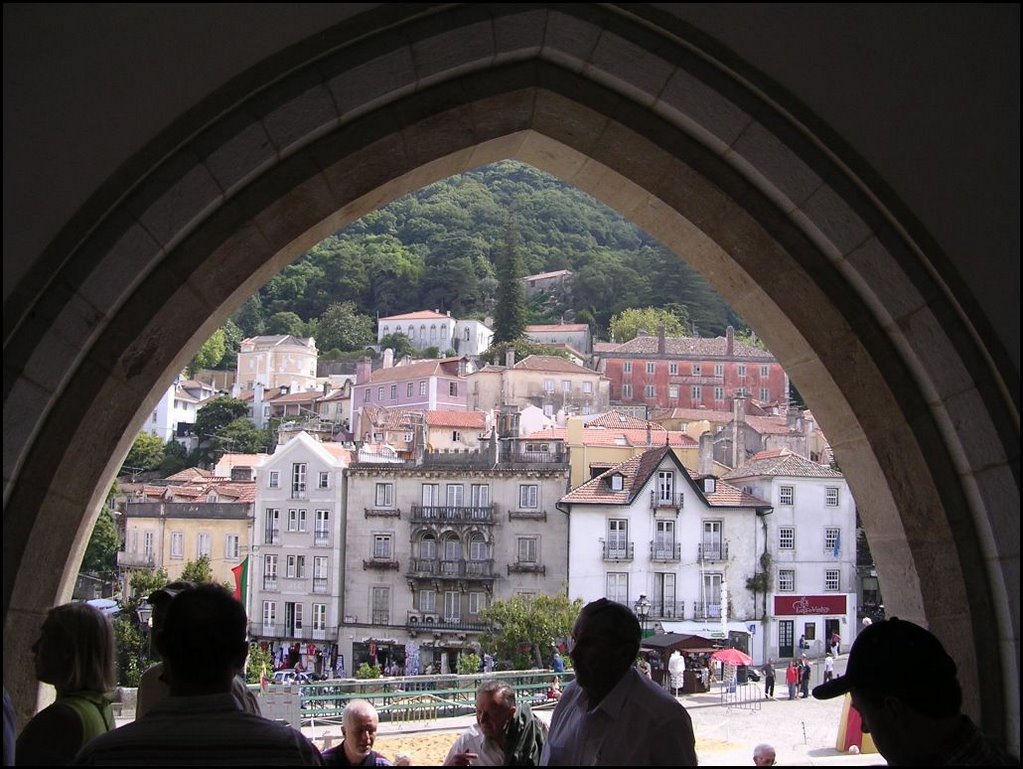
Images: The first image is of the National Palace in Sintra, Portugal. (The link has a better picture). All of it is old, but parts of it, the chapel, for example, are very old. Can you see the arches? The second picture is taken from the palace, looking at the town itself through the arches. Great bakery in the picture, plus a little shop where Steve bought me a garnet cross. The last picture is of the seaport town of Cascais.

Labels:

Tuesday, November 28, 2006

Sermon on the Mount

Class tomorrow will be based on chapter 7 of Yancey The Jesus I Never Knew book – the Sermon on the Mount Chapter.

Have you read it in one big chunk? Do that, and I imagine you will come to understand how difficult it can be to hear, and to attempt to live. I love Yancey’s line, “Jesus made the law impossible for anyone to keep and then charged us to keep it.”

Think about what is said (just a few snippets):

  • When you manipulate words to get our own way, you go wrong.
  • I’m telling you to love your enemies. Let them bring out the best in you, not the worst.
  • Too many of you are using that as a cover for selfishness and whim, pretending to be righteous just because you are legal.
  • You can’t worship God and money both.
  • Don’t pick on people, jump on their failures, criticize their faults…
  • The way to life – to God! – is vigorous and requires total attention.
The list goes on and on. We look at it, and think, “No way. I cannot meet these expectations.” And Yancey’s right – Jesus never opens up a loophole for us. He never says, “Well, do the best you can.” He never tells us that it is OK for us to be less than this. Why would he? We already are less than this.

There is a line in the United Methodist Ordination service which asks the candidate, “Are you going on to perfection?” and “Do you expect to be perfected in love in this life?” Daunting questions. I think, though, that we can ask them of ourselves as well as candidates for ordination. Think of perfect as meaning, instead of flawless, complete and whole. We can grow toward completeness and wholeness. I think an understanding of this will help us to grasp the Sermon on the Mount. Hold that thought, and I’ll connect it in a minute.

Why did God send Christ? There are lots of answers to that question, and none of them may be complete, but I could list reasons such as to redeem us, to bring us into relationship with Him, to reveal himself to us, to show us what grace is all about.

If Jesus’ purpose (or one of them) was to reveal God to us, and to bring us into relationship with God, then can’t we look at the Sermon on the Mount in that light? Yancey does. He says, “For years I had thought of the Sermon on the Mount as a blue-print for human behavior that no one could possibly follow. Reading it again, I found that Jesus gave these words not to cumber us, but to tell us what God is like.” Jesus – showing us what God is like – telling us what the Kingdom of Heaven is like.

That doesn’t mean Jesus is saying that “You don’t have to do this. You are excused from living this kind of life.” He’s not telling us that it is OK to be less – he’s telling us that there is MORE. He’s showing us what completeness – wholeness – looks like. This is what God is like, and this is what he wants for you.

The Sermon on the Mount is not a list of laws or rules. It’s harder than that. We make a mistake, though, if we ever again try to look at what God is doing in the world without seeing it through grace. God wants more for us that for us to live by a set of laws. He wants us to be whole, and he’s given us grace to get us there. The Sermon on the Mount shows us what perfection in God is all about. If we stand here defeated in its shadow, then we miss the point completely. The point is that God knows we can’t get to wholeness on our own – he wants US to understand that. He wants us to know that he loves us enough to give us Christ – we are made whole through him – through grace.

He doesn’t want us to ignore the Sermon on the Mount because it is too hard. He wants us to know how hard it is, so that we will stop ignoring HIM and the grace he offers.

Images: More from Lisbon. The first one is where the Tagus river meets that Atlantic. Right at the end is the Tower of Belem, which is beautiful (built in 1515). The second picture is also of the river, but a little bit further away from the Atlantic. There are several restaurants sharing building space -- looks like a warehouse -- right on the river. They all have outdoor seating. We were having dinner one evening (outside) and took this picture of the view. Notice the bridge? It is the 25 de Abril bridge. It's similarity to the Golden Gate is not coincidental. Both bridges were built by the same construction company -- in two cities where earthquakes are a major concern. The statue across the river is of Cristo Rei (Christ) -- similar to the one in Rio de Janeiro. The last photo is another one of the Jeronimos Monastery, taken from the top of the Monument to the Discoveries.

Labels:

Wednesday, November 15, 2006

Salty Teaching

Driving J to school this morning was a little bit like an episode of Jeopardy. He is always full of questions, but this morning was a little bit excessive:

  • Mom! Are you going to a funeral today? (Yes, I’m wearing black. I wear black a lot – Did he just notice? Maybe it’s not the black; maybe it’s the celery green shirt?)
  • Mom! (All questions start with Mom!) Have you ever broken a car? Have you ever shut the car door and the hinges break and the door falls off? (Apparently, I don’t know my own strength.)
  • Mom! (See?) Do you get to pick the church you go to, or do they (whoever they are) tell you which church you have to go to?
Questions. He comes up with LOTS. Are we open to questions?

I stopped by Beth Quick’s blog yesterday. She was reviewing the book How (Not) to Speak of God by Peter Rollins. Be aware as you read this post (my post, I mean), I’ve never heard of this book, and have not read it.

She explains Rollins’ description of conceptual idols. That thought caught my attention. If an idol is anything we place above God in importance, then a conceptual idol is an IDEA we have of what God is like – the image of God that we have in our minds. It becomes an idol when we hold so tightly to what we THINK God is like that we are not open to revelation of what God is really like. We cling to OUR image of God, rather than to God himself. We normally think of an idol as a physical representation of a god; a conceptual idol is an intellectual representation of a god.

Do you do that? I do that! When I read the last chapter of Yancey’s book yesterday, I underlined parts, put stars in the margins and even wrote “Yes!” in a couple of places. Do I do that because what he is saying is a new, startling idea? Sometimes. Sometimes, though, I’m doing that because he is saying something that I agree with. That’s not learning – that’s affirmation of what I think I already know.

What are the dangers of conceptual idols?

Anytime we place anything – including an idea – above God in importance, that idol becomes an obstacle. Not only is it above God in importance (in our minds), but it also stands between us and God. Beth quotes Rollins: “They (the Pharisees) held so closely to their interpretation of the Messiah that when the Messiah finally appeared in a form that was different to what they expected, they rejected the Messiah in order to retain the integrity of their interpretation.” What was in their minds and their tradition was more important to them than the God standing in front of them.

None of us can grasp God completely. When we try – when we concentrate him down into a little box that we can hold and understand, we make him too small. We reduce him to less than he is. Sometimes that is necessary so that we can gain some kind of understanding of him, but we need to always keep in mind that what we know of him is less than what he is. Our conceptual idol – our idea of God – will always be wrong, because it can never be BIG enough.

When we are convinced that what we believe it right and true – and that what other people think is not – then we close ourselves off from a valuable means of grace – Christian conversation. One of the ways in which God reveals himself to us is in that push and pull of trying to understand God within the Body of Christ. That’s way too valuable to ignore just because what the other person is saying is different from what you (or I) think.

We have minds created and designed by God so that we can seek him – look for him. We have the need to try to understand him – a God-given yearning to connect with him. All of that is good, and right. We should never assume that we are finished with that process. Rollins says in his book, “Instead of religious discourse being a type of drink designed to satisfy our thirst for answers, Jesus made his teaching salty, evoking thirst.”

Drink of the salty water and never be satisfied with your conception of God – for He is more.

Labels:

Tuesday, November 14, 2006

The Beatitudes -- A Summary

Each Tuesday (except for one) since September 5, I've taken one of the Beatitudes and used it as the theme of a post. I've been thinking for the past week that I needed a final post -- kind of a summary of what I've discovered. On Monday evening, I printed all nine posts out, and read through them as a whole, trying to find a unifying theme for this last post. No such luck. I'm not entirely convinced that I did a very good job with them at all.

Ironically, tomorrow the chapter that is to be discussed in the class that JtM and I are teaching is one concerning the Beatitudes. While I was contemplating my posts, I was also rereading the chapter in The Jesus I Never Knew. Yancey thinks that there are three facets of meaning to the beatitudes. The first time I read the chapter, a few weeks ago, I finished it with a feeling of confusion. As I read it today, knowing that we were teaching it tomorrow, I outlined his thoughts and tried to mesh them with mine. This will have to serve as my summary for this series:

  1. Dangling promises -- Jesus knows what is to come -- what the kingdom of heaven will be like in its fullness. We live in the kingdom now -- we are striving to make it come into being here, but Jesus has seen the goal -- the end product. He is telling us, especially those of us who are suffering, that there are better times ahead. We live in Saturday, but Sunday's coming! I like CS Lewis' quote, "if we consider the unblushing promises of reward and the staggering nature of the rewards promised in the Gospels, it would seem that Our Lord finds our desires, not too strong, but too weak." Perhaps in Jesus' eyes, we are all the unfortunate -- all the suffering, and he is telling us that we should turn our eyes to the future, when the suffering will end. If we knew that, if we believed that, then perhaps we would devote ourselves more completely to making the kingdom come now, here, where we are -- especially those of us who have the means. Another good quote, "To believe in future rewards is to believe that the long arm of the Lord bends toward justice, to believe that one day the proud will be overthrown and the humble raised up and the hungry filled with good things." To go back to Weatherhead's description of the ultimate will of God, then perhaps Jesus is describing God's ultimate will -- what will come, even though his intentional will is not a reality.
  2. The Great Reversal -- Does God have a preferential love for the poor? That statement goes against the idea that we are all children of God -- loved and cherished by him. Perhaps the best way to see it is that those who are poor -- whether in material possessions, family, spirit, or in any other way -- are in a position that makes it easier to reach for and to accept God's grace. "Poor people find themselves in a posture that befits the grace of God. In their (in our, when we are poor, in any way) state of neediness, dependence and dissatisfaction with life, they may welcome God's free gift of love." He gooes on to say, "Human beings do not readily admit desperation. When they do, the kingdom of heaven draws near."
  3. Psychological Reality -- "The Beatitudes reveal that what succeeds in the kingdom of heaven also benefits us most in this life here and now." If the beatitudes are "dangling promises" of what life will be like the kingdom of heaven, then they are also a description of the results of losing one's life -- and gaining it back -- here and now. If "dangling promises" are a description of the result of God's ultimate will, then the beatitudes are also a description of how God will work through us, if we allow him, to bring about his will. In the here and now, living a life of purity and mercy, hungering for righteousness, taking a stand for justice, and by focusing on God instead of ourselves, can bring a life of grace -- blessings -- joy. It is a reversal of what society tell us, but Jesus is trying to tell us that in this way lies God. He isn't waiting for us only at the end of the road, but he is also standing at the beginning of the path, hoping to walk with us along the way.
I walk away from this with no real confidence that I've come to understand what the Beatitudes mean, but perhaps with a little bit more understanding of what they don't mean, and an inkling, I hope, of their depth of meaning.

List of Links:
Beatitudes
Blessed are the Poor in Spirit
Blessed are those Who Mourn
Blessed are the Meek
Hungering for Righteousness
Blessed are those Who Care
Blessed are the Pure in Heart
Blessed are the Peacemakers
Blessed are the Persecuted

Labels:

Thursday, November 09, 2006

He became vulnerable

In reviewing the chapter we covered last night in class (The Jesus I Never Knew by Philip Yancey), I stumbled across this paragraph:

The display of power in the midst of a storm helped convince the disciples that Jesus was unlike any other man. Yet it also hints at the depths of Incarnation. “God is vulnerable,” said the philosopher Jacques Maritain. Jesus had, after all, fallen asleep from sheer fatigue. Moreover, the Son of God was, but for this one instance of miracle, one of its victims; the creator of rain clouds was rained on, the maker of stars got hot and sweaty under the Palestine sun. Jesus subjected himself to natural laws even when, at some level, they went against his desires (“If it is possible, may this cup be taken from me”). He would live, and die, by the rules of the earth. (p.91)
We’ve been focusing in this class on the humanness of Jesus. What was he like? His ministry? His personality? What would it have been like to have known him as a person? This paragraph, for me, however, draws the focus away from his humanity, and shines it on his divinity.

Think about it for just a minute. God. The maker of the universe. The God who set the stars in motion, who taught the ocean waves to land on the beach, and who started my heart beating, became vulnerable. He subjected himself to the same rules of nature that he had set into motion. How incredible is that?

What does that mean?

  • It means that he felt pain – in the carpenter’s shop, when the hammer slipped off the nail and smashed into his thumb, he knew pain. When the nails were hammered into his hand, he knew pain. He made himself vulnerable to US – to death on a cross, and yet he was God.
  • It means that when his earthly father died, perhaps when he was a teenager, he knew the immediate, close up pain of loss. And not only that, but he saw the effects of death on those close to him – widowhood for his mother, and what that meant in the time in which he lived.
  • It means he not only saw the result of poverty from the throne of God, but he felt it. He felt hunger, thirst, sleeplessness and illness. That vulnerability resulted in the invasion of germs, the pain of fever, maybe sea sicknesses and unhealed wounds.
We talk often about the sacrifice of Jesus on the cross. By no means do I intend to lesson the cost of that event, but I’ve never considered until now that the Incarnation was a sacrifice as well. The God of the universe, who stood in front of Job and reminded him of His majesty, decided that we were worth so much to him that he would become one of us, and take on all that that implies. Our humanity.

It also means to me that when we try to deny his humanity -- to lessen it -- that we are reducing the sacrifice that he made by becoming human in the first place.

Labels:

Wednesday, November 08, 2006

What did we notice?

At class tonight, we looked at several different scriptures and then discussed a word or phrase that would describe the emotions or personality characteristics Jesus displays.

Matthew 27:46 -- desperate, human, fear, quotes scripture, disappointed, abandoned, "Where were the 5000?" pained, expresses pain

Mark 1:40-41 -- compassion, cares for individuals, sensitive, healer, those being healed must ask for help out of faith, loving, fearless (brave), accepting, reactive (immediate response), available

Mark 3:1-5 -- defiant, non-traditional, radical, confrontational, good questions, fearless, smart, thinker

Mark 6:30-31 -- humanity, needed rest, tired, mothering, protective of friends, loves friends, leader, need for solitude, need for renewal

Mark 6:35 -- concerned, tenacious, compassionate, tenaciously compassionate, purposeful, responsibility taker, teacher, parental, extrovert, perceptive, shepherd

Mark 14:34-36 -- humanness, helplessness, child, range of emotions, fear, obedience, willing to be compliant with God, acceptance of difficult task, humility, doesn't want to be alone, need for companionship

Luke 10:21 -- happy, excited, smug

Luke 19:41-44 -- sorrowful, angry, regretful, rueful, honest, blunt

Luke 23:34 -- unbelievable compassion, forgiving, generosity, pain

Luke 23:43 -- fulfillment, prophetic reassuring, decisive, gracious on the cross, unselfish,

Luke 23:46 -- trusting, resignation, relief, hopeful, child-like faith

I thought that there were some interesting responses -- words that I hadn't thought of.

And do you know what this is? This is post #400.

Labels:

Thursday, November 02, 2006

No More No Less

The chapter that our class covered last night in our book study of Yancey’s The Jesus I Never Knew was called Temptation: Showdown in the Desert. When I read this chapter the first time, I liked it. If you were to look at my book, you would see lots of underlining and stars in the margin – moments of ah ha. This week as I re-read the chapter, worked on the lesson, and discussed it with the other teacher of the class, I found that I was learning even more. It’s the work of preparation behind the teaching, and it can often be a blessing. It was this week.

One “ah ha” moment has been in my mind today. The scriptural basis for the lesson was Matthew 4:1-11 – the temptation of Jesus. If you remember, the second temptation was for Jesus to jump off the temple and be saved by angels (verses 5-7):

For the second test the Devil took him to the Holy City. He sat him on top of the Temple and said, "Since you are God's Son, jump." The Devil goaded him by quoting Psalm 91: "He has placed you in the care of angels. They will catch you so that you won't so much as stub your toe on a stone."

Jesus countered with another citation from Deuteronomy: "Don't you dare test the Lord your God."
Yancey postulated that this temptation must have been especially appealing to Jesus. Protection. An end of the vulnerability that he was facing. Later in the gospel he is still tempted when Peter assures him that he need not give away his life, Jesus responds, “Get behind me Satan.” (Matthew 16:23). Even on the cross, the temptation is almost played out again. As he is being crucified, the teachers and elders mocked him and said, “He trusts God. Let God rescue him now if he wants him….” (Matthew 27:43). Yancey writes, “But there was no rescue, no miracle, no easy, painless path. For Jesus to save others, quite simply he could not save himself. That fact, he must have known as he faced Satan in the desert.” It had to have been a temptation – to save himself.

Are we ever called to do that? Are we ever called to step into vulnerability in order to help others? I think we are, and I think we called to it often.

Mercy Me has a song on their Coming up to Breathe CD called No More No Less. The chorus:

Let me introduce myself to you
This is who I am
No more no less
I am just a man who understands
Because of you I’m blessed
No more no less.

I’ve mentioned before that Andy of Enter the Rainbow is working on his ordination papers, and that he is posting excerpts on his blog. Today’s question was regarding the human need for grace. He talks about three kinds of isolation – pride, prejudice and isolation. I’m only going to talk about the isolation here, but go read his definitions of the other two – they’re great. Pretentions. We have them – we pretend that we are more than what we are – that everything is OK. We pretend that we are less than what we are. To quote Andy, “Pretensions separate people from one another by inhibiting true relationship based on openness and honesty."

God calls us to vulnerability. Let me introduce myself to you – this is who I am. No more, no less. What are our weaknesses, our strengths, our gifts, our failures? Not only are we called to recognize them, but we are called to lay them on the line – to put them “out there” to be used by God as he would. No more, no less. To make ourselves vulnerable for the benefit of others.

On the West Virginia Annual Conference page, Dr. Bill Wilson talks about a “false sense of self” which leads to three temptations – to be liked by all, to be perfect, and to have it our own way. We do that, don’t we? I do. I think we are called away from all of these temptations and called to risks and vulnerability.

This notion of exposure – placing it “out there” – is part (not the main part) of why I write on this blog.
Let me introduce myself to you
This is who I am
No more, no less.

Keep me honest. Keep me real. Keep me from pretensions.
Lead me not into temptation.

And a tidbit for JMers -- I found a sentence in chapter 8 of the book that I'm paraphrasing -- We are called to Common Ground, as sinners equally desperate in our need of God.

Labels:

Wednesday, November 01, 2006

What are our temptations?

As part of class tonight, I asked those attending what their temptations were. On the spur of the moment, I wrote the list on the board:

food
drink
gossip
cursing
judgmental
procrastination
lust
pride
anger
losing patience with people
speeding
lying
criticizing

Labels: