Tuesday, June 07, 2016

Prayer: The Vertical Component


So, why do we pray?  Sometimes, when my two boys would ask "Why?!" I would say, "Because I said so."  Why do we pray?  At the simplest, the answer to that question is "Because God says so."  But I do think there is more to it.

The James scripture is the last few verses of the book of James.  It is a letter that was written, not to a particular church, like Ephesians or Corinthians, but to scattered churches. It concerns itself with heavenly wisdom, as opposed to worldly wisdom, and it urges Christians to live a life that reflects their beliefs.  Perhaps the most famous verse from the book of James is part of the second chapter, verse 26: for faith without works is dead.  The book of James has three main concerns: taking care in how we speak, showing care to those in distress and living lives that resist worldly sins.  I think it might be surprising that a book so full of action would end on words that encourage prayer.  And yet, Pope Francis said, "You pray for the hungry.  Then you feed them.  That's how prayer works."  There is wisdom for us in that.

For me, a cross illustrates the function of prayer in our lives.  There is the vertical bar - it represents the commandment to love God - and prayer is our connection to God.  There is the horizontal bar - representing the commandment to love our neighbors as ourselves - and prayer connects us to community.

When I think about prayer, I'm stunned and amazed that the creator of the universe wants us to pray.  As a child, I took it for granted.  As an adult, I know that it is extraordinary that God offers us an invitation to be in relationship.  Think about that for a moment.

But it's not only that - God not only wants to be in relationship with us, but God wants to partner with us in the work of God in the world. Mark Douglas wrote, "...prayer uniquely binds human and divine activity together such that it is difficult to see where one ends and the other begins."

A few years ago, I had a stack of "thinking about you" greeting cards on my desk.  I was considering what to do with them.  I took some time in prayer, and while I was listening, being quiet, a few names came to mind, so I sent the cards to those people.  A week or two later, one of the women to whom I sent a card made a special effort to stop by to see me (from out of town).  She said that she had been in the hospital, and the card arrived the day she got home, and it was exactly what she needed to hear - she had been so encouraged by it.  The truth is, I didn't know she was even sick, and yet I sent her a card.  God did that.  I did that.  I don't know where the dividing line is, but it is prayer that makes it possible.

Philip Yancey wrote in his book Prayer, "The partnership binds so tight that it becomes hard to distinguish who is doing what, God or the human partner.  God has come that close...the advance in intimacy is striking."  The truth is, God has work for us to do, together, and that is why we pray.  And I challenge you to get that close to God and not be changed.

Labels: , ,

Wednesday, February 04, 2009

The Reality of Grace

In his book The Life You've Always Wanted, John Ortberg says, "Confession is not primarily something God has us to do because he needs it...We need to confess in order to heal and change." He talks about how we often think of confession as being legalistic -- make a confession and have a sin erased -- transactional. Instead, confessional should be transformational.

It reminds me of a description of prayer from the class JtM and I taught on Yancey's Prayer book. Prayer should develop a relationship with God, and yet so often we use it because we see it as a transaction with God.

I was looking for something else this evening on Ye Ole Blog, and I found this quote sent to me in an email from JtM, back in 2006:

There is no union with God without transformation. Paradoxically, the person who has struggled with personal transformation and become psychologically stronger is the person who can be empty and receptive before God. This vulnerability is an act of strength, since we no longer need to hold tightly to a false self that protects us from our inner pain and fears. We are free at last.
Confession. Is there anything that makes us more vulnerable than confession? To admit before God that we are wrong is to become vulnerable before God (and ourselves). Confession empties us -- our hearts and hands and spirits -- so that we can be open before God and accept the freedom of forgiveness and grace.

Ortberg also says that confession is not just the idea of grace, but is the reality of grace. God doesn't ask us to do it our of his own self-interest, or out of a need to hear our admissions. Better than we know, he knows how it can be grace.

In a post by Songbird, she states:

And I sobbed, too, because this is what God wants from us, not rules and rituals and lines of exclusion. God wants the I'm sorry written on our hearts, sobbed and sung and wrung out of us,...

Labels: , , ,

Saturday, March 08, 2008

Roll the stone and set him free

One of the lectionary readings for the week involves the story of Jesus raising Lazarus from the dead. I think that this may be one of the clearest examples of Jesus using a miracle to increase the faith of those around him. He says, "For your sake I am glad I was not there, so that you may believe. But let us go to him" (John 11:15).

We talked in the Wednesday Night class this week about being in partnership with God. Yancey explains in his book "Prayer" that we are in partnership with God. God could certainly do all of this on his own, but he chooses to work in the world with and through us.

Take this story, for example. Jesus has the crowd roll away the stone. He doens't just lift it out of the way; he calls on the community to move the stone. Then, once Lazarus has been raised, Jesus tells those who are gathered, "Unbind him, and let him go." The miracle is participatory.

We are called to do the same as we nurture each other in the faith. We are called to open doors for people -- any way that we can. We are called to unbind others -- freeing them from what keeps them from life lived in God. It's a broad ministry, but it's our job.

Labels: ,

Wednesday, February 27, 2008

Bringing out the best

I ran across a post today on Cheesehead in Paradise which discusses this scripture -- Romans 12:1-3 (although I'm just listing verses 1-2):
So here's what I want you to do, God helping you: Take your everyday, ordinary life—your sleeping, eating, going-to-work, and walking-around life—and place it before God as an offering. Embracing what God does for you is the best thing you can do for him. Don't become so well-adjusted to your culture that you fit into it without even thinking. Instead, fix your attention on God. You'll be changed from the inside out. Readily recognize what he wants from you, and quickly respond to it. Unlike the culture around you, always dragging you down to its level of immaturity, God brings the best out of you, develops well-formed maturity in you.
A couple of things jumped out at me. First of all, "take your everyday, ordinary life...and place it before God as an offering." We talked this evening in class about how difficult it is to surrender our problems, our worries, and our concerns to God. We hang on to them. Look at this sentence though -- God doesn't only just want our worries and problems. He wants even those parts of our lives that are ordinary -- our sleeping and eating. Everything.

The second thing (actually it was the first phrase I pinpointed) as that "God brings out the best of you." That's amazing to me. Why have I never thought of that? It could be a handy way to judge if an action is of God or not. What if we were to ask ourselves, "Does this action bring out the best in me?" We might not like the answers. We might not be ready to give up those things which are not of God.

Labels: ,

Friday, February 15, 2008

Imprecatory Prayer

Before I start talking, consider this story.

A Southern Baptist minister, Rev. Wiley Drake, in Buena Park, CA, is being investigated by the IRS for "mixing politics with religion" (that's a quote from Yahoo!, not the IRS). Rev. Drake wrote a press release, using church letterhead, personally endorsing Mike Huckabee, and calling on all Southern Baptists to do the same. He then discussed the endorsement on "The Wiley Drake Show" -- an internet broadcast from his church, in which he said, "Yes, I endorsed him personally and yes, we use the First Southern Baptist Church. Yes, we broadcast the 'Wiley Drake Show' from the First Southern Baptist Church. Everything we do is under the auspices of the church."

His lawyer now states that his client has a right to free speech, and that his statements were a personal endorsement, not a church endorsement, "and he made that very clear."

I leave that determination up to you and the IRS.

What I want to write about today is one of Rev. Drake's responses to this investigation.

Americans United for the Separation of Church and State filed a complaint with the IRS. Drake later lashed out at them in an Aug. 14 press release and urged his supporters to direct "imprecatory prayer" toward two of the group's officials, Joe Conn and Jeremy Leaming. He gave as examples of imprecatory prayer: "Persecute them. ... Let them be put to shame and perish" and "Let his children be fatherless, and his wife a widow."
This blog asks the question -- is imprecatory prayer a response that the church should be using?

If you haven't heard of it before, Rev. Drake's examples are illustrative of this type of prayer.

In our Wednesday evening class this week, we discussed the idea that God is able to handle our anger as well as our prayers. Upset with God? Tell him. Angry with God? Tell him. Rant and rave, God can handle it, and we have several examples of these kinds of prayers in the Psalms. But should we ask God to direct our anger against other people? How does that mesh with Jesus' command to love our enemies and to pray for those who persecute us?

First of all, trust God. He is God. While I do believe that there is power in prayer, I do not equate that power with the power to the stick a pin in a doll and have injury come to the human likeness of the doll. God is not "into" voodoo. Do I believe that Rev. Drake's imprecatory prayers will bring harm to those against whom he prays them? No. I thank God that we have a God who will answer prayer wisely.

As a parent, when your toddler stomps his foot and tattles on his little brother, demanding that you punish the younger brother for his "wrongful acts," do you take direction from the toddler? No. Is it sinful for the toddler to be that angry? I don't know, but I do know that God, like a parent, can handle our temper tantrums.

Don't filter your prayers. Give it all to God. I think that this kind of honesty in prayer will draw us closer to God; it will help us to develop a relationship with our heavenly father. And as we do, then perhaps we will notice that the imprectory prayers sound false in our mouths. Bitter. Jesus came to show us a better way to live; a life of grace and transformation.

Labels: ,

Wednesday, January 30, 2008

What's the View?

If you had 20 children, could you love them all? I'm not asking if you could buy them all cars or spend endless "quality" time with them -- could you love them all? I think we could. I think love is limitless, and we have an unending supply of it.

We're teaching from Yancey's Prayer book on Wednesday evenings. The premise of the first session is that we need to step back and realize that God sees the world from a God's eye view. Imagine the looking at the ground and seeing tiny little ants crawling around. The God's eye view of us is kind of like that -- tiny, small people in a huge universe.

I get one of the purposes of his analogy. We are not individually the center of the universe. And that's a lesson that I think we often need to remember.

However, we are all God's children, infinitely and perfectly loved by God. To him, to his God-sized heart, we are not specks or ants. We are his children. We are each important to him, and the tiny details of our lives matter to him.

A friend from church sent me a link to a mural in the city of Cochrane in Canada. Go see it at this link. When you do, click on the horse's eye. Yes, I know, it sounds silly, but go do it.

The eye, which to me looks just like an eye in the mural, is actually an individual piece of art, which doesn't look like an eye at all. Carry this analogy out to these conclusions:

  • God sees the whole mural of life. We can't see it, but he does.
  • To God, each individual piece of it is important. He values the beauty of each little one.
  • The individual images are done by different artists -- each with his own style and artistic talent. We are all different.
  • Together, we are a church, assembled by God.
  • The name of the mural is Trust. That says a lot, doesn't it?
While we may be small in the universe, and the world certainly doesn't revolve around us, we are important and valued by God.

Labels:

Wednesday, July 25, 2007

Don't Give Up

Do you have a teenager? Have you ever been subjected to the "Bargainer?" The "Bargainer" is the child who asks to/for something, and then, in response to "no" from the parent, begins to argue, to discuss, to wrestle and to bargain with the parent. Come to think of it, it is not just my teenager that does this; my 10 year old does it, too. Bargainers, both of them.

Take a look at two of the lectionary readings for this week:


  • Genesis 18:20-32 -- This is the passage where Abraham bargains with God concerning the destruction of Sodom. I've always really liked this passage because it shows a relationship between God and Abraham. Abraham, even though he knows he is speaking with God, feels brave enough with God to try to change His mind about the destruction of the city.
  • Luke 11:1-13 -- In this passage, Jesus teaches the disciples about prayer. He reminds them to be persistent in prayer. He tells them to seek, to ask, to knock, and that God will provide the answers.
I was thinking about these two passage together this evening, and about what a comparison between the two might tell us. I was reminded of Yancey's Prayer book. He reminded us that "Abraham quit asking before God quit granting." Have you ever thought of that?

God, for some reason that we do not always understand, wants us to struggle with him. He wants us to not give up; he desires our persistence.

Perhaps it is because, as we westle with God, as Abraham does, that even though we do it with our own goal in mind, God has a different goal. We cannot walk away from true relationship with God without being changed. We come to God, asking him to make changes in the world around us, and we often walk away with God having made changes in the world within us. Perhaps he struggles with us because transformation isn't easy, but he knows that if he allows us to constantly bump against him, we will be reshaped.

From Yancey's book:
We are all children of Israel, implied Paul, all of us God-wrestles who cling to God in the dark, who chase God from room to room, who declare, "I will not let you go."
Images: Pine needles up close and daisy up close at the VA today.

Labels: , , ,

Friday, March 23, 2007

Partnership

Do you ever promise to pray for someone and then forget? I do. I try to solve that problem by praying at just the moment the request is made, while it is on my mind, but other times, the prayer needs to be done closer to an event, or more than once.

Do you ever pray for someone, and feel like your job is done? "I said my prayer; I'm done!"

Are you ever in a situation and feel God move you to pray? Last week, I was involved in our worship service -- involved meaning my attention was caught by it -- I was worshipping. At that moment, a friend came to mind, and I prayed. I wonder now if God triggered that prayer, and if the request was needed right then.

A few weeks ago, I was in church, and the same thing happened, except that this time I was praying for the person right in front of me, who was delivering the sermon. The sermon was going well; there seemed to be to me no reason why the prayer was needed, but later that person told me that he had prayed during the sermon for God to be in control, so I think my prayer coincided with his, and I think God prompted my prayer.

Why would that be? Why would God prompt me to pray for something he already knew about? Why would he ask me to pray for something that he was going to do anyway?

I think the answer lies in a concept Yancey calls partnership in his Prayer book. He brought forth the point that God desires to be in partnership with his children to do his work in the world. He says, "from the very beginning, God has relied on human parterns to advance the process of creation."

God wants so much for us to be in partnership, that he comes, grasps us by the shoulder, and says, "Pray. Pray now for this reason. Be my partner."

The partnership binds so tight that it becomes hard to distinguish who is doing what, God or the human partner. God has come that close...the advance in intimacy is striking.
Image: Sunrise on the way to work the other day.

Labels: ,

Tuesday, March 13, 2007

Driving Forward

When my mother was 16, her aunt taught her how to drive. She went for a visit, spent a week, and learned how to drive. My grandmother didn't drive, and my grandfather was working out of town at the time, so my aunt was "it."

The only problem was that Aunt Sue didn't teach Mom how to back up. She could only drive forwards. When it was time to pull out of the driveway, Mom just turned in a circle in the front yard, and pulled out. It makes one wonder if she ever used the rear view mirror at all.

When I started to drive, Mom and I went to an empty parking lot, and I learned how to back up. Mom was determined. I am an excellent backer-upper, thanks to this repetition to learn the skill.

The Disciplines writer for Monday's devotion talks about life being like driving a car while watching in the rear view mirror. The significance of life's events only make sense if we look at them in the past. But that's no way to drive a car!

In the book Prayer, Yancey says, "What is faith, afterall, but believing in advance what will only make sense in reverse?"

God has cared for us in the past; faith is having the trust to believe that he will care for us in the future. "We have always done it that way," is not a faithful response.

When we know God is holding us in the palm of his hand, then we are empowered to step forward in faith, not understanding the designation of the path we travel or the viability of the side roads that we might pass. There becomes no need to look a the past, but, in faith, we can examine the future with the trust that God will be there with us.

We can save the reverse gear for leaving the driveway.

Labels: ,

Monday, March 12, 2007

Give it up. Or not.

Yesterday's post was about Lent, and how I haven't made a deliberate commitment to a spiritual discipline during these several weeks. Bob left the following comment on the blog:

I don't think you can grow on a schedule, it just happens. That's not to say you can't put your self in the right places for growth. I find that growth happens best when we least expect it. I lead a Bible study at church and teach a Sunday school class, sometimes it feels stagnant, just one big routine. Someone new will show up and give fresh perspective and all of a sudden I'm experiencing God anew again from a different angle...

My question for today is to examine the role of a intentional commitment to a spiritual discipline -- a deliberate routine -- as compared to the spontaneous intrusion of grace. Are the two in opposition to each other?

Like Bob, I am a Sunday school teacher, and I have certainly experience what he describes. There are times, when I am teaching, that I see God from an entirely different angle. My "new view" may be triggered by comments made my members of the class I am teaching. I may see something new as I prepare for the lesson. Some of the most amazing revelations of grace occur as I am teaching. There have been times when I have a thought that I have never touched on before, but which arrives, like a gift, as I am speaking.

I do believe that God arrives in our lives with no warning, when he is least expected. Looking at it with a different perspective, though, read this Philip Yancey quote from Prayer:

A rabbi taught that experiences of God can never be planned or achieved. "They are spontaneous moments of grace, almost accidental." His student asked, "Rabbi, if God-realization is just accidental, why do we work so hard doing all these spiritual practices?" The rabbi replied, "To be as accident-prone as possible.

And then this one, from the same book:

Aha moments catch me be surprise. A sense of gratitude, a ping of compassion. But they catch me, I have learned, only when I am looking for them.

I think we can find God more often when we are closer to him. I think we will be soaked in his grace more often when we are standing close to the source. I can understand what Yancey means when he says we need to be spiritual disciplines to become accident prone.

I write this blog. I do it everyday, even though there are times when I would rather not. Some days there is no immediately apparent topic for a post. Some days I have to dig to find the topic. It's a discipline. It is a way that I try to be accident prone.

I think it may be that "routine" work -- something picked up because of Lent -- that I have missed. It doesn't help that I keep getting asked, "So what did you give up for Lent?"

"I've given up answering questions like that!"

Image: Crocuses in our yard. SPRING!

Labels: ,

Friday, March 02, 2007

God is Near

In the stillness,
In the quiet,
In the heaviness of life,
I search for you.

Grant me patience,
Grant me calmness,
Quiet my spirit,
Allow me to rest in your presence.

Relieve my fears,
Banish my anxiety,
Remove all obstacles
That keep me from your grace.

And may my prayers
Lift from my heart
And find your company.

Amen.

The prayer above was written as I read the Yancey book, Prayer. As I finished chapter 20, I wrote it in the margin at the end.

Also from that chapter, I wrote down a few quotes:

  • Listening is an art, and I must learn to listen to God.
  • Our job is to remain attached, to abide.
  • Ninety percent of prayer is showing up
  • Without prayer, my attention moves to my own preoccupations.
  • The power of prayer has helped recreate me.

Some mornings my prayers are connected to God, and they take me closer to God, as if I am on wings. Other times, nothing like that happens, and I have to struggle to concentrate, to even form prayers.

I was in the little chapel once in the church in Ashland, with Steve, JtM and MT. We were taking a few moments to prayer before a worship service. I don't even remember what the four of us prayed. What I remember the most is that we were in the presence of God. He was with us, and the most important part of our prayer time together was just that we "showed up." The most important part was that the four of us had taken the time to come together, and that we had met God in that room.

My reunion group has started a new tradition. At the end of each meeting, we join hands and pray. I have been surprised at how easy it is -- by easy, I mean relaxed. It truly feels as if we have invited God into the room, he has pulled up a chair, and we are spending time with him. During the first time we did this, I remember laughing. Joy. How great is it to find joy in prayer?

When we gather together and experience the presence of God -- the joy of God -- I think we can safely assume that God is pleased.

Image from Hermanoleon Clipart.

Labels: ,

Monday, February 19, 2007

Letting God be God

I've mentioned earlier that I read the book Prayer by Philip Yancey. I've been thinking a lot about prayer since I was on the Emmaus team last October.

Since I finished the Yancey book, I've noticed a change in my attitude toward prayer. Do you ever debate with yourself the validity of your prayers? Others' prayers? Are you like me, finding yourself with a judgmental attitude about what I should pray about? About what other people should pray about?

Do you ever find yourself criticizing the person who prays for a parking space? The person who prays about his homework? The success of a project at work? Do you ever wonder if certain concerns are too small to bring to God?

At Common Grounds one Thursday before Christmas, two prayer requests were submitted for community prayer -- one each from a husband and wife. Each of them were a asking us to pray that they would be able to buy his our her spouse a Christmas present. Have you ever prayed that kind of prayer? To this couple, to be able to provide each other with a Christmas present was a huge accomplishment, and a really heavy worry. I think God wants to hear us voice those concerns -- no matter what.

Do you ever edit your own prayers? Do you ever think, "I'll just pray for those things that I think God might wish to grant? Do you ever say to yourself, "I'll only pray for those things that I think he might find to be important or of value?" In addition, I've wondered if praying for disruptions in the "natural law," such as safety while traveling or healing, might be asking God to do something that he wouldn't normally do.

But then I read the Prayer book. One of my take home messages from the book was to let God be God. I've decided to pray about whatever is important to me. I'll ask for whatever is on my mind. God is God; I am not. He can look at what I pray and decide what is best. It's a form of faith. It's a form of trust. It's letting go of control, and giving it to God.

When I think about it, it's how my children talk to me. They ask for anything and everything. As the parent, it's my job to look at the big picture and to answer their requests from my adult viewpoint. If my kids trust me to do that, then I will trust God to do that as well.

Images: The sunrise as seen from the interstate today and proof that I live in Never Never Thaw Land -- our road, still snow covered.

Labels: ,

Wednesday, February 07, 2007

J's Prayer

J created a book in Sunday school a couple of weeks ago. On the pages of this little book, the members of his class traced the outline of their hands and wrote their names on the pages. He was asked to bring the notebook home, place his hand on the outlines in the book, and to say a prayer for the one whose hand outline was on the page.

Steve helped him at first. They both placed their hands on the book, and Steve said the prayer. Eventually, J was doing it on his own. He begins with a prayer, and then he prays for each member of his class, and, if he knows them, the family of the member. The other day at dinner, he asked if he could say grace. There's my 10 year old, praying for us. How amazing is that?

I've mentioned before that I read Philip Yancey's new book, Prayer. I find that in watching and listening to my son, I see illustrations for Yancey's words:

  • "We don't need to try to get God's full attention; we already have it." Even a 10 year old, who is being guided through prayer using a notebook with outlines of hands, has God's full attention. Isn't that wonderful?
  • God "has simply been waiting for us to care about them with him." Whether it is J who is asking God to bring two of the students back to Sunday school, or an adult, praying for healing for a young child, we don't have to convince God of the worthiness of the person for whom we are praying. God already knows about those who need his help. He is just waiting for us to care about them with him. "God woos, and waits."
  • "90% of prayer is showing up." It doesn't really matter what J says in his prayer. The fact that he is praying, and that God is listening, is the real blessing.

Prayer -- it's an amazing thing to see in my own 10 year old the work of God as He builds a relationship with my son. Amen.

Images: The first one is our dog, Molly. The second on is G, our older son, jumping over the unshoveled part of the driveway this morning as Steve shoveled.

Labels: ,

Friday, January 26, 2007

Precarious

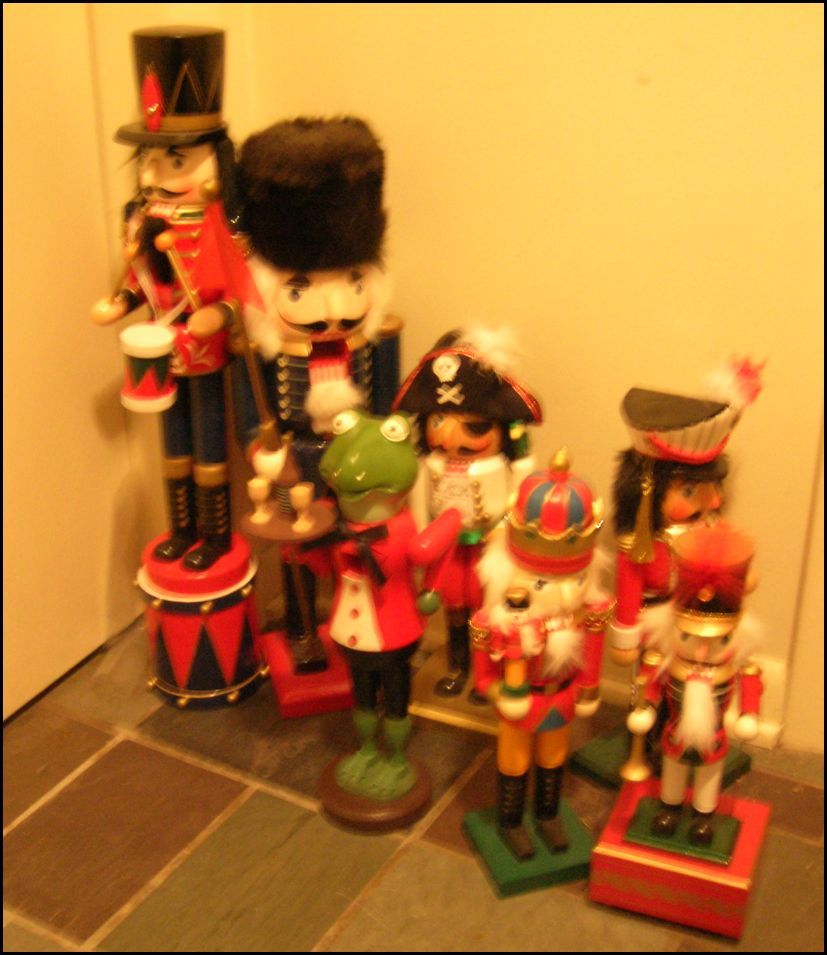
We have a small grouping of nutcrackers in our entryway. Yes, they are still there. And, no, we haven’t put the Christmas decorations away yet. We will. But why are you worried about it?

Anyway, you can tell by the picture that at this point, they are not particularly artfully arranged. You’ll see why as I tell this story.

See the frog? He was one of those items I saw in the store that was so ugly that I had to buy it. Most people didn’t feel that way. JC Penney’s still had about 100 of them when I brought froggie home. I’m just sure he dances in his spare time. Steve wasn’t with me when I bought him – he probably would have stopped me. “Kim, he’s not cute; he’s ugly.”

“I know he’s not cute. But he’s a dancing frog! I know he is. And he’s half price!”

Apparently yesterday evening (I missed this event – Steve saw it all), Froggie had lost his footing (maybe in some wild dance move while we were at church) and had fallen down. J saw him, and said, “The frog fell over. I’ll fix it.” So as he leans over to pick up the frog, his backpack (full of books for homework) swings around off his back and bowls into all of the nutcrackers, and he got a strike! Every one of them crashed to the ground.

Life is like that sometimes. There are unintended or unanticipated consequences to our actions. It’s hard for a 10 year old to predict the future, and sometimes it’s just as hard for us adults to make decisions which take into account future consequences.

Could it be that that is one of the benefits of prayer and the resulting relationship with God? I’m sure that it is. According to Philip Yancey, in the book Prayer, the word prayer is related to the word precarious. Aren’t we often in precarious positions? When the outcome is uncertain? When we feel a little lost and unable to predict the future?

I would never have known this, but JtM looked up precarious today, and the first definition is “depending on the will or pleasure of another.” Prayer. It certainly functions as a means of communication with our creator. Here we are, in the world, and perhaps it’s when we realize that we are dependant upon the will or pleasure of God, that prayer becomes that very necessary vehicle of communication. Perhaps then it becomes the way that God can give us guidance through the unanticipated and unexpected consequences of what we do.

Labels:

Friday, January 19, 2007

Purpose of Prayer

I've mentioned before that I'm reading Philip Yancey's newest book, Prayer. I'm a little over halfway through, and I like it.

What is the purpose of prayer. I can think of all kinds of reasons not to pray, but as you read the Bible, you will find numerous examples of prayer, including prayers of Jesus. Obviously, it has a purpose, and just as obviously, God expects us to pray.

Yancey says, "The main purpose of prayer is not to make life easier, not to gain magical powers, but to know God."

I was listening to a song my Mercy Me called On My Way to You. The lyrics:


Almost there, almost where I'm supposed to be
It's not all clear, but you keep showing me
With every step, the more my heart moves to your beat
Just like where I'm headed, there's joy in the journey

Teach me to think like you think
Show me the things that are true [ohh]
Finish the work you have started in me
As I'm on my way to you

Create in me a pure heart and make me new
Less of me, Jesus more of you
Here I stand, still I'm drawn down to my knees
It's not my strength, but Your's that carries me
It occurs to me that this is one of the purposes of prayer -- it is to engage in a relationship with God. We tell God what is on our mind, and he shares with us who he is. Relationship.

Image source: Free foto.com -- this link

Labels:

Sunday, January 14, 2007

Gifts?

Last Wednesday, during the book study that JtM and I teach, we had a "side" discussion about gifts. It wasn't the main point of the class, but a few minutes were spent on the topic.

One woman, who has found her ministry in the church, serving food to our Common Grounds congregation, was speaking passionately about the Thursday night service. Someone else in the room mentioned that her own gifts did not lie in that area.

This evening, I was reading this post (that's a hyperlink) which is the main points of a sermon concerning 1 Corinthians 12. She called the post "Like Fingers Need a Thumb." We all have gifts from God. All of us. Gift discernment is important; we need to be self-aware and "God-aware" enough to figure out what God's gifts to us are. We also need to listen carefully to those around us who can see our own gifts better than we can at times.

The idea which worried me from the Wednesday class is that sometimes we look at what someone else is doing in church, and we say, "I can't do that -- that's not my gift." We forget, or we ignore, that we all have gifts. Just because we are not gifted to do one particular thing, doesn't mean we get a "pass" on doing anything at all.

The point of the sermon to which I linked above is that we need each other. We are a body of Christ. She writes:


The truth is, we do God no favors when we try to ignore/downplay/deny either our own giftedness or the reliance we have on the giftedness of others. And it doesn’t work anyway, not in the way God intends for things to work together for the goodness of all. In doing so, we deny the very inbreaking of the Spirit that we are promised in the gospel, and we attempt, albeit feebly, to subvert God’s plan for the church.
We need to find our gifts and put them to use. We also do no one any favors by denying that we have gifts. We NEED each other -- we need each other to use our gifts.

One of the gentlemen in the class that I taught this morning was discussing the benefits of a life lived with God compared to what society describes as a good life. What he was hinting at was that when we find our gifts, and use them for the benefit of the body of Christ, and to glorify God, we will find joy. We will be blessed beyond our imagining.

Labels:

Friday, January 12, 2007

Prayer Expectations

I’ve started reading Philip Yancey’s new book, Prayer. I’m five chapters in, and so far, I’m liking it. I’m writing all over my book – stars, underlines, comments. I’ve only been reading it for two days, so 1/5 of the way through is a pretty good indicator that I like it.

He ends chapter 5 with a discussion of the differences between men and women. I wrote the word "stereotypes" in the margin of the book (OK, actually, if anyone comes after me and reads my copy of the book, I wrote more than that – but let’s stay on topic). I have a real problem with assuming we know people by looking at them through the lens of a stereotype, but for the sake of argument, let’s follow through with this one, because I think it brings up an interesting question.

Understand that Yancey is describing the discussion that occurred at a class he was attending. The class was engaged in conversation about the book You Just Don’t Understand by Deborah Tannen.

The theory is that women "lament." Tannen actually uses that word as a kindler and gentler form of another, harsher word. In comparison, men are more likely to be “fixers.” Women want sympathy or empathy, and men either want to fix the problem or be silent about it (Right – men NEVER lament). This particular part of it sounds suspiciously like Men are from Mars, Women are from Venus to me.

Tannen explains that women bond through suffering – that we connect through the affirmations gained through lamenting. Men, on the other hand, see no purpose in complaining if the problem cannot be fixed. If it can be fixed, then they feel an instinctual need to fix it.

I’m not going to argue the validity of this theory, except to say that I know that men complain, and that I also know women have the need to 'fix' things (just ask my mother). To be totally honest, I do both. There are times when all I want is an ear to hear my problems – I have no need for anyone else to fix them (the problems, I mean, not my ears). Other times I have a real need to FIX a problem, and grow impatient with the lack of action that I sometimes see.

Ignoring the lack of universal truth in the stereotype, let’s carry it forward into the idea of prayer. Do men pray with an expectation that God will fix the problem? Do women pray with only a need for God to hear their lamentations? If that is the case, then do we look at how God answers prayers differently? Do men generally expect an action from God while women do not?

What do I think? I think that Yancey would tell me that I’m looking at prayer from the wrong direction. I like how he defines the purpose of prayer in the earlier chapters. "The main purpose of prayer…is to know God." To quote Tim Stafford as mentioned in Yancey’s book, God "already cares about the things we pray about…He has simply been waiting for us to care about them with him."

So the question might most effectively be asked, "What are God’s expectations of prayer?" Is he disappointed in our approach to communication with him? One more quote, this time from Abraham Joshua Heschel, "Contact with Him is not our achievement. It is a gift, coming down to us from on high like a meteor, rather than rising up like a rocket."

Amen.

Image: Sunrise over interstate this week.

Labels: