Monday, August 03, 2026

Walking outside the boat

 In 2008, I changed careers. I was hired as the Associate Director of The Foundation. My college and graduate training, and my career to that point had all been in the fields of biology and medicine, particularly research. The change to work at a foundation that focuses on legacy giving and stewardship was quite a leap.  At the time, I compared it, in my mind, to Peter, and how he stepped out of the boat to attempt to walk on the water in Matthew 14:22-33.

I don't mean that comparison to sound pretentious or overdrawn, but truly, for me, making this career switch had the feeling of embarking into a new land, a new field, where I knew nothing, other than faith and a sense of the purpose of the church. I truly relied (and continue to rely) on any gifts God had given me, even those that had nothing specific to do with the work I am doing now. I saw (and still see) ways the two fields relate to each other, but it is not direct or obvious.

At the time, I had recently read a book by John Ortberg called If you Want to Walk on Water, You've Got to Get out of the Boat. It inspired the metaphor in my mind - if I wanted to follow, to have faith, to trust in God, then I had to step out of the boat

As I read the Matthew passage today, it reminds me of that time, but what I noticed today is that Peter doesn't show a lot of fear when he steps out of the boat.  It was later, after he had left the boat and was actually walking on the water, that the fear - the realization - set in.

Beginnings do bring fear, and it is fear that we must work through, but we shouldn't think that from that point on, the water will be smooth, and there will not be encounters with that which frightens us. There will be.  It is necessary to keep the faith, to look to Jesus, and to continue to overcome the fear.

Labels: , ,

Saturday, December 09, 2006

Silence

We took J with some friends to go see The Nativity Story this week. J likes to ask questions -- all through the movie.

Nobody really likes to sit next to J during a movie. You either answer questions the whole time, or sound like you've sprung a leak, "Shhh. Shhh."

On the way home, J asked, "Why did God make it so Zechariah couldn't talk?"

I think that's a good question. Why did God do that?

I've always thought of it as punishment, and I've never liked that answer. It seemed out of character for God.

One of the devotions this week in Disciplines talked about this question in a way. The author is John Copenhaver, a professor at Shenandoah University in Winchester, Virginia. He says that Zechariah is our model of waiting in Advent. He waited nine months for the birth of his son -- for the arrival of a child promised by God.

Silence. Time spent not speaking. I've only ever practiced the deliberate discipline of silence for an extended period one time (anyone on an Emmaus walk has) -- if you can call an hour an extended period of time. I think perhaps that God didn't place Zechariah in silence as a punishment, but perhaps as a preparation for what was about to happen. Perhaps God knew what was best for this particular child of his -- Zechariah -- and gave it to him.

Do we ever do that? Do we ever fast from speaking? I can see a few different applications:

  • An extended period of silence and solitude can remove us from distractions. Ortberg in The Life You've Always Wanted, says that the great danger is not that we will renounce our faith, but that we will become so distracted/rushed that we will settle for a mediocre version of it. We will just skim through life instead of living it.
  • What about silence during prayer? What about if instead of listing wants and desires to God, we were to sit and listen for God. Instead of deliberately composing prayer, let your prayer muscles be silent, and just sit and think. God will work his way into that, and will start leading us in our silence.
  • Sometimes, I think the discipline of silence just means listening. Stop talking, stop planning your next conversation contribution, and just LISTEN to the person in front of you. We have such difficulty making what the other person is saying more important than the thoughts we want to express. Sometimes we just need to stop talking, and to listen.

Image: Zechariah from the Nativity Story.

Labels: ,

Monday, December 04, 2006

Availability

Last week I did a procedure in the lab that involved using sound waves to tear apart cells and release the proteins inside of them. The equipment used to do this is called a sonicator. You may not realize it, but you’ve probably seen one – it’s the same kind of equipment that is used in a jewelry store to clean jewelry – sound vibrates the dirt away.

I wonder if that is comparable to parents trying to “shout” out stains. Probably not.

Anyway, the sonicator we have at work concentrates its sound waves through a probe which is inserted into the tube of cells in solution. The problem is that the sound is intense – high pitched – and can cause damage to the operator’s hearing if used often enough. To prevent that, I wear ear protection which kind of looks like big ear muffs. No, I’m not posting a picture.

Wearing that PPE (personal protective equipment), I am temporarily deaf – to prevent permanent deafness, I suppose it’s a fair exchange. I can hear myself breathing, my feet hitting the ground, but only very loud sounds from outside myself. Isolation. (Actually, I slip very small earphones under the muffs and listen to music while I sonicate – better than hearing myself breathe.)

I’m still reading Ortberg’s The Life You’ve Always Wanted. The chapter I finished today was about the practice of Servanthood or “appropriate smallness.” One of the ways that Ortberg says that the discipline of servanthood is practiced is through a ministry of being interrupted – a ministry of availability.

The chapter brought to mind for me my children. Do I practice a “ministry of availability” for them? How many times do I tell them “Not now.” Or “let’s talk about that later.”? Can I tell you how impatient I get with our younger son and his homework? Believe me, I don’t do homework well when I’m tired – and neither does he. I would much rather Not Be Available.

The Ministry of Availability requires us to set aside our own agenda and to be interruptible – to prioritize someone else’s needs above our own. It might mean listening to a child practice a solo for a school play when you would rather be getting the dishes washed and put away. It might mean listening to a discussion about the newest movie preview that the oldest son has seen rather than talking about what happened at work that day. It could mean trying to explain long division to a very tired and grumpy 10 year old. I give you these examples because these are all ways I have failed to be available in the past week.

I think I may need to begin some practice in this discipline.

I think I may need to come out of my isolation.

I think I may need to listen to more than myself breathing.

I think I may need to be more interruptible and more available.

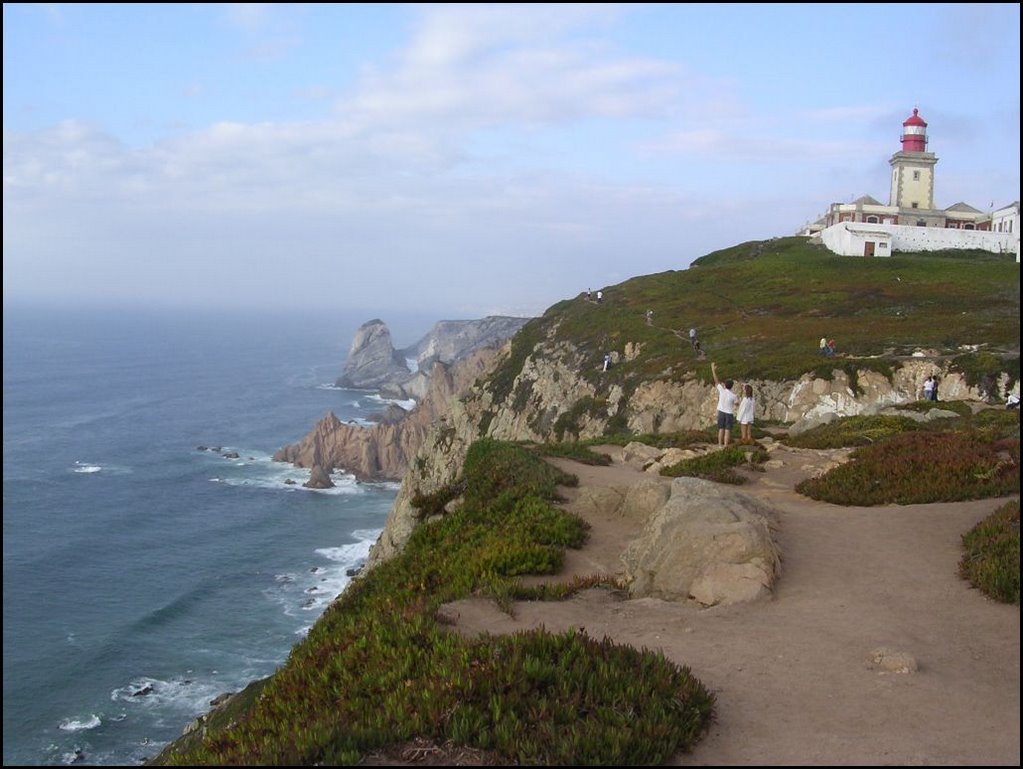
Images: Both of these are of the most western point in Europe -- Cabo da Roca. Doesn't the Atlantic Ocean look different than how we think of it? It is all a matter of viewpoint.

Labels: ,

Sunday, September 17, 2006

Trust or Fear

I wrote in this post about trust versus fear. We either trust or we fear. Ortberg goes on in the same chapter to say that fear disrupts faith. I found this weekend that this is true.

I've said "yes" to a change that will probably happen at the beginning of next year. I'm doing it out of faith -- trust -- that God will help me to do the task which I have agreed to do. Most of the time, while I don't feel comfortable about it, I at least feel as if it was the right choice.

Yesterday a man at church, who I respect and think highly of, said something to me which knocked me from trust to fear. I had no easy answer for him at the time, and as the evening and this morning went on, I found that, to my surprise, the comment was continuing to gnaw away at my trust that my decision had been the correct one. I shoved it to the back of my mind (where things fester) and went on my way.

Steve and I attended a district event this afternoon. Our bishop was in the area and was preaching at a district worship service. It was a great event -- enthusiastic music, worship outside (I'm a sucker for worship outside). Our district lay leader (who is also the infamous Jeff the Methodist) delivered the prayer. It began with a moment of silent prayer. I didn't expect it; I didn't plan it, but the spirit in me reached out for God, and He reached back. I left that moment or two of silent prayer touched by God, and knowing that He was with me, step by step.

The Bishop's sermon was outstanding, but two lines really stuck with me from the afternoon.
  • You have to trust God. Are you willing to trust God?
  • Do not be afraid. (He said it with such force and emphasis that it hit home)

I am a person who was pulled off the path by a remark that was certainly not intended to have the effect that it did. God passed by me this afternoon, and nudged me back in place. Hopefully, the experience of this will make it more difficult for me to wander off the path of faith in the first place. In other words, I hope I've learned something today.

Labels:

Thursday, September 07, 2006

The More We Trust Him

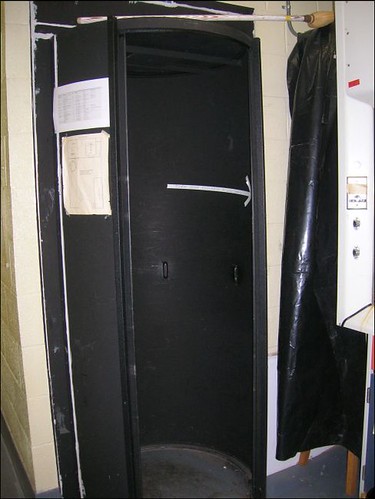
Part of my job sometimes involves developing X-ray film. To do that I have to go into a darkroom in the medical school next door where the film processor is. This room is about the size of a closet -- maybe 6 x 6 feet -- and it has a revolving "tube door." To enter the room, you step into a tube, turn the wall of the tube so that the outside is closed off, and then you can step into the little room -- the little, completely dark as the inside of a cow room. Step in, and then flip on the lightswitch.

There's something scary about a completely dark room. I know that no one is in that room, and yet someone COULD be in the room -- or maybe a research associate-eating giant mutant bat has taken up residence on the ceiling. YOU NEVER KNOW. I hate the two steps from the door to the light switch.

What role does fear play in our walk with God? Ortberg says that fear and trust are in opposition as we work to "step out of the boat." He thinks that fear is the number one reason why people stay in their nice, safe boats rather than risking the trip out on the water. God is telling us to trust Him, and we are countering that request with all of the fearful reasons why that is not such a good idea. We have to choose whether trust or fear will win.

Look at this line from The More song:

And the more I know You, the more I need You
The more I love You, the more You become to me

Ortberg makes an important point -- one that I think we often miss. We often allow fear to win because we think that the cost of trust -- or the consequences of failure -- are too high a price to pay. We often fail to realize that giving into fear has its own cost. The more we allow fear to win, the easier it is for fear to win the next time. Once we trust, then we learn that God is trustworthy. Our willingness to trust is increased each time we learn more about the trustworthiness of God. Each time fear wins, our opinion of ourselves is decreased. We think, more and more, that we can't handle the big steps (or the small ones). We get an image of ourselves that is one of fearfulness. The cost of giving into fear is that it changes our view of ourselves. The reward of trusting God is that we come to know him better -- His trustworthiness is made known to us.

I read somewhere, and maybe it was Ortberg's book, but I can't remember, that we often think that we need more faith. We don't need more faith (remember the mustard seed?). We need to know God more. And maybe the only way we can do that is to learn to trust Him, in spite of our fears.

Last January, Jeff the Methodist sent an email to our Sunday school class (Can I just say I love having 2GB of email storage? I never have to delete an email) about a view of heaven.

A sick man turned to his doctor as he was preparing to leave the examination room and said, "Doctor, I am afraid to die. Tell me what lies on the other side." Very quietly, the doctor said, "I don't know."

"You don't know? You, a Christian man, do not know what is on the other side?" The doctor was holding the handle of the door; on the other side came a sound of scratching and whining, and as he opened the door, a dog sprang into the room and leaped on him with an eager show of gladness.

Turning to the patient, the doctor said, "Did you notice my dog? He's never been in this room before. He didn't know what was inside. He knew nothing except that his master was here, and when the door opened, he sprang in without fear. I know little of what is on the other side of death, but I do know one thing. I know my Master is there and that is enough."

May today there be peace within you. May you trust God that you are exactly where you are meant to be.
The last lines of the chapter "Crying out in Fear" from Ortberg's book:

But whatever you do in faith,
every time you trust me,
Whenever you act in risky obedience and jump in response to my invitation --
That you will have forever.
Go ahead and jump.

The more we know him, the more we'll trust him, the more we'll love him, the more he'll become to us.

Image: Image of the "tube door." The tape arrow on the inside says "Turn this way to avoid jams." You know, I always follow that direction. Apparently, someone else has had bad experiences in the room -- there is now a paper towel sign inside on the wall that says, "DO NOT place chair in front of door." Yes, please. The other photo is the best I could do for the inside of the cow -- red dark room light.

Labels:

Wednesday, September 06, 2006

Get Down

I’ve mentioned before that I’m reading John Ortberg’s book If You Want to Walk on Water, You’ve Got to Get Out of the Boat. Yesterday I finished the "Seeing the Wind" chapter.

What is the wind? If you think of the story of Peter walking on the water, the wind – the storm – is what distracted him. It is what took his eyes from Jesus and was the catalyst as he began to sink. The wind is the difficulties in our lives – the challenges – the hardships. Ortberg uses the story of Joseph from the Old Testament to illustrate many of his points, and he uses it well. I think that one of the themes of the entire book of Genesis is that God can take the challenges of life, and use them for his own purposes – to love his children. Listen carefully – I did not say that God causes them – only that he is active in our lives, and doesn’t sit on his hands by when the wind comes.

What happened when the storm arose on the Sea of Galilee? What happened when Peter began to sink? "At once Jesus reached out and grabbed hold of him and said, ”What little faith you have! Why did you doubt?" (Matthew 14:31) There it is – God’s response to the wind in our lives. Jesus reached out and saved Peter, and then gave him an opportunity to learn from what had happened – an opportunity for growth.

I was struck when I read this chapter by the idea of theophany – God making himself known to us. Ortberg calls this “God passing by…” We often think of our encounters with God to be mountaintop experiences – glorious, see the wonder of God, times. We think of the transfiguration, Moses on the mountain receiving the Ten Commandments. We think of those times in our lives when we have felt the presence of God so closely that he could have been standing next to us. Like Peter, we want to build a tent, and stay put, basking in the presence of God.

But what kind of God would we have if he only made his presence known on the mountaintop? To quote Ortberg, “Sometimes God comes, not in those moments when we are most lifted up, but when we are down the lowest in the place of vulnerability and fear. Sometimes he comes, not on the mountaintop, but in the storm.” I’m thinking of Job on his ash heap, Jonah in the belly of the whale, Jacob in the desert, and even Adam and Eve OUTSIDE the garden of Eden. I’m thinking of the walk to Emmaus, when Jesus walked with two believers in what was one of the lowest points of their lives.

We have a God of the Mountaintop, but we also have a God of the Storm. While we celebrate the mountaintop glory, I imagine that we treasure the experiences with God in the valley the most. God always lifts us up, but even more so when we need it the most -- in our lowest times.

I heard this song on the way into work today – it’s called Get Down by Audio Adrenaline – selected lines:


All I needs another day
Where I can’t seem to get away
From the many things that drag me down, yeah
I’m sure you’ve had a day like me
Where nothing seems to set you free
From the burdens you can’t carry all alone
In your weakness he is stronger
In your darkness he shines through
When you’re crying he’s your comfort
When you're all alone, he’s carrying you

I get down and he lifts me up
I get down

This valley is so deep
I can barely see the sun
I cry out for mercy, lord
You lift me up again
My arms are too short -- a good, and somewhat related post (title is a hyperlink).

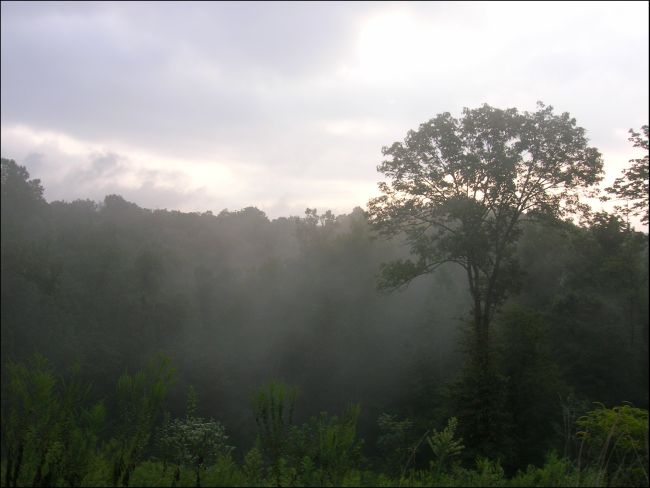
Images: Views from the VA hill this morning.


Labels:

Tuesday, September 05, 2006

The Beatitudes

I’ve been thinking about the Beatitudes today, and doing a little reading about them. I’m toying with the idea of a series of posts about them – I’m not sure how that will work out, but I do have some thoughts about the Beatitudes as a whole.

I found an internet source today for a set of lessons for children based on the Beatitudes. The general philosophy of the lessons was that Jesus explained to us what behavior are necessary to be happy. To quote the site, “Jesus gave us eight Beatitudes. Follow these Beatitudes and you will be doing the right thing all the time and you will make Jesus very happy.” I’m sorry, but what a load of malarkey. I can’t believe that anyone would teach that to children. What awful pressure to place on a child. “You will be doing the right thing all the time?” Where’s the grace? This is number 1 on my list of What the Beatitudes are not – they are not a list of what to do to make Jesus happy.

I found out today that the word “blessed” in the Beatitudes is translated from the Greek word makarios. I like Wikipedia’s literal translation of that word: "possessing an inward contentedness and joy that is not affected by the physical circumstances." I think that the word blessed in the usual translation of this section of Matthew is misleading. The way we normally read it, blessed connotes gifts – we are blessed because we receive gifts from God. Think about a Beatitude: Blessed are those who mourn, for they will be comforted (Matthew 5:4). If we read “blessed” to mean receiving a gift from God, then is it too far a stretch to read this passage as “God blesses us with mourning so that we will be comforted”? I personally think that that kind of translation is misleading. John Ortberg, in the book that I reading now, says that that kind of theology -- that all human suffering is merely a moral object lesson from God -- "trivializes human tragedy and blasphemes God's character." Amen. Number 2 on my list of what the Beatitudes are not – they are not a list of the ways in which God will bring us heartache so that we will learn that He has the power to make us happy.

I also think that the Beatitudes are not a checklist. Only if I am mourning, or meek or hungering for righteousness, will I be blessed by God. I don’t believe that this is a list to be used by us to compare our lives against. We shouldn’t read the Beatitudes and come away with the feeling – “Wow, my life is just too good for me to truly know the blessings of God.” These are also not steps to take to get to know God. In other words (number 3), the Beatitudes are not The Way.

So, what are they? I think Jesus is painting a picture for us of what life can be like in the presence of God. When we read them as a description of life with God, then they make so much more sense in the context of the entire picture of God that we find in the Bible. What are they? The Beatitudes list the evidence of grace. Instead of describing The Way, they tell us what happens after we begin to walk with God. They are a description of what it is like to live a life surrounded by grace. At least, that is my working theory.

If it works out, I may take each one and use it as a starter for a post – not right away, but over the next few weeks. We’ll see if anything I think about the Beatitudes makes any sense at all.

Labels:

Saturday, August 19, 2006

Swing Batter Batter

I don’t particularly like country music. I do like it now more than I used to (it’s much less cuunnn-ttttree than it used to be), but I make no real effort to search it out or to listen to it. The other day I was “browsing” the channels on TV and stopped on one of the country music video stations. The song Swing by Trace Adkins was playing. I really like the chorus, and I’m going to steal it for this post, although you should know that I’m using it in a way that it was not originally intended. (OK, OK, I like the song as is, too, and I really like the video).

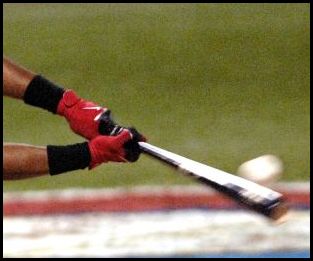
Swing Batter Batter Swing Batter Batter Swing Batter Batter Swing

(Maybe in this case, the lyrics NEED the music. If you go here, you can click to a preview of the video and hear the song)

You may have noticed in the sidebar that I’ve started a new book – If You Want to Walk on Water, You Need to Get Out of the Boat by John Ortberg. It’s another one off Steve’s bookshelf. I’ve read one chapter, and so far I’ve found tons of little gems. Here’s one:

Failure is not an event; failure is a judgment about an event.

Wow. How true, and how odd that’s I’ve never thought of it like that before. We are constantly labeling our actions or ourselves as failures because we make a judgment about an event. We spend our lives living in a world in which society tells us what failure is – we allow the people around us to define failure for us, and tell us that we need to avoid it at all costs. We go so far as to believe that we, as a person, are a failure, because society defines an action or event that we have experienced as a failure.

  • Society may tell us that we are a failure as a parent because our child is addicted or lost when really the greater success is that we continue to love this child even amid these seemingly insurmountable challenges.
  • Society may tell us that our marriage was a failure when really the greater success, the blessing, in fact, is the life that followed the divorce.
  • Society may tell us that the cancer treatment was a failure, when the success is actually the additional year of life that it allowed – when the success is the number of lives touched and changed during that year as people witness the presence of God.
  • Society may tell us that the end of a job is a failure, when the success is found in the way we cope with finding a new career, and the triumph of a new career built on the ashes of the old one.
Think of Peter as he walked on the water. Some would say that he lost his focus on Jesus and sank – a failure. Ortberg goes on to say that Peter is the only one who “swung his bat.” He was the only one who experienced what it was “to do what he was not capable of doing on his own, then feeling the euphoria of being empowered by God to actually do it.” Then, when he sank, he was the only one who was able to experience the saving grace of Jesus after “failure.” Jesus was there for him – he picked him up when he was drowning.

Sounds to me like Peter didn’t fail at all – or at least his failure was much less than those other eleven who stayed in the boat.

Swing Batter Batter Swing Batter Batter Swing Batter Batter Swing

Labels: