Thursday, February 22, 2007

A Place of Resurrection

Rend your hearts, and not your clothing (Joel 2:13a, NRSV)

I went to an Ash Wednesday service last night. The minister said that we need to make sure that we practice our spiritual disciples in the quiet – just us and God. I’ve heard that before, but I’ve never thought of the reasoning behind it. The reasoning discussed was that if we pray or fast or do whatever it is that we do that brings us closer to God in public, that we will do it for approval. I’ve always thought of abstaining from the public practice of these habits because I might do it to impress someone, not our of fear of trying to gain approval, but maybe that may be true.

The key to the reasoning was that if we do these things to gain the approval of someone else, then we will miss the great benefit of doing them in the first place – we will miss out on the deepening of our relationship with God. Do we try to deepen our faith to win someone else’s approval? Perhaps we should be trying to win God’s approval instead. No "perhaps" about it!

Change your life, not just your clothes (Joel 2:13a, The Message)

What would changing our spiritual clothes mean? Would it mean changing the way we appear to others? So what is the role of community in spiritual discipline? I’m reading John Ortberg’s book Everybody’s Normal Till you get to Know Them. The chapter I just finished is called the "Wonder of Oneness." It has some great thoughts regarding the trinity, which I’m sure that I will return to. But for now, consider these thoughts about community:

No matter how little money we have, no matter what run we occupy on anybody’s corporate ladder of success, in the end what everybody discovers is that what matters is other people. Human beings who give themselves to relational greatness – who have friends they laugh with, cry with, learn with, fight with, dance with, live and love and grow old and die with – these are the human beings who lead magnificent lives.
We often hear how we have a God-shaped hole in our hearts that only God can fill. Ortberg says that we also have a human shaped hole, that God has placed there, and that he will not fill. We need each other.

Rend your hearts, Change your life…

So, if we are to change our hearts – our inner selves, but we are made to be in community, how do we do that? Ortberg quotes Les Miserables and says, “To love another person is to see the face of God.” So perhaps, as the quote above says, when we “give ourselves to relational greatness;” when we love one another, we are practicing a spiritual discipline. We are moved closer to God.

It doesn’t depend on approval or impressing anyone. “A community is not simply a group of people who live together and love each other. It is a place of resurrection.”

Labels: ,

Tuesday, December 19, 2006

Rule of Life

I'm getting close to finishing John Ortbert's book The Life You've Always Wanted. I haven't had much time to read lately, but perhaps today I'’ll get to the end (one more chapter).

The second to last chapter is called Life with a Well-ordered Heart: Developing Your Own Rule of Life. Ortberg defines a "well-ordered heart" through Augustine's words: To have a well-ordered heart is to love the right thing, to the right degree, in the right way with the right kind of love. It is to be transformed -- it is not that we "are not only increasingly free from sin, but also increasingly free from the desire to sin." He then goes on to say that we need a plan to reach a well-ordered heart. He calls this a "rule of life." This is not a set of laws, but is instead a set of something which is done regularly. A plan.

Ortberg gives a strategy for transformation which involves asking ourselves a set of questions for the develoment of a "rhythm of living" that will draw us closer to God. I liked the questions, but as I was reading them, I thought that, in addition to being questions that we should ask ourselves in our development of a rule of life, that they are questions that we as a church should be asking of the Body of Christ of which we are a member:

I've paraphrased the questions so that they will be applicable to church life, but I hope I've left Ortberg's intention intact.

How and when will we pray as a church? Do we pray as a body of Christ? I don't specifically mean the morning prayer in the Sunday worship service. I think we need to examine the prayer life of our churches. Do we lift up the idea of prayer as important? As a church, do we pray about what we need to do, how we need to do it? Do we ask God, as a church, to be involved and present in his house? One church I visited has a prayer table in the sanctuary. As the acolyte came in to light the altar candles, he stopped at this table, and lit the candle that was placed there as well. It brought light to their prayer effort; it brought their prayer effort to light. Do we pray for the programs in our church? Do we prayer for our members? Do we pray for our pastors? Do we pray for our children? Are we communicating with God at all as a Body of Christ?

How will the church handle money in a way that draws us closer to God? One way to determine the priorities of a church is to look at its budget. If we are serious about what we are doing as a Body of Christ, then the way we plan to spend God's money should reflect our perceptions of how God wants us to be at work in the world. Our spending plan for God's offerings and gifts should be guided by His vision for His church. The church's budget should be a tool of ministry -- one which enables the Body of Christ to be doing God's work in the world. Whose priorities are reflected in the church's budget?

How can we approach work in a way that will help Christ be formed in the members of the church? If our mission is to go forth and make disciples of Jesus, then how is it that what we DO as a church makes that happen? The Director of Leadership Formation and Spiritual Support of our Annual Conference, JF Lacaria, wrote a column for the November issue of the WVUM newspaper in which he explains that the phrase "so that..." will make fruitful change in the ministry of God's church. What we do as a church -- our work, our actions -- should be done with an eye to the "so that...." For example, our church has a Thursday evening service with a meal so that the homeless and marginalized in our neighborhood will be fed, both body and spirit. What we DO should be in accordance with the vision God has for His church -- so that Christ will be formed in our members.

How are we involved in Christian Community (such as corporate worship, fellowship and confession)? I see many ways in which we could examine this question as a church, but the one which first comes to mind is whether we are CONNECTED as a Body of Christ. Does our worship create a relationship with God for our members? Are our members connected to each other through fellowship? Do we hold the Body of Christ accountable to God? Does the church act in such as way that it is evident that we love God and that we love each other? Do we communicate with each other? Do we strive to forgive each other, enable each other, support each other. Are we a Body of Christ at all?

How can the church fill its daily tasks with a sense of the presence of God? If we are a Body of Christ, then how is it that our daily life as a church reflects Christ to other people? I think this particular question calls us to examine the details of our life as a church -- the "small stuff" (which so often is the building blocks of the "big stuff"). How can people tell, just by watching us, that God is with us -- that we even care what He has to say or that we are willing at all to humble ourselves as a church to his will? Are we welcoming, even in small ways, even to those who are different than ourselves? Do our steps through life as a church -- one by one -- carry us to the destination that God intends? Is our church life filled with words of gratitude or are we colder than that? Do we see our daily tasks through the eye of scarcity or the eye of abundance?

What is our church's rule of life? If we summarize these questions, then to approach a closer relationship with God, we need plan to pray, incorporate God's priorities into our budget so that we plan to spend His money the way he intends, order our activities so that each thing we do will be an instrument of God for our transformation as a church, strive to be connected as a Body of Christ, to God and to each other, and incorporate God into each detail of our church life.

Why would we do this?

And whatever you do, in word or deed, do everything in the name of the Lord Jesus, giving thanks to God the Father through him. (Colossians 3:17)

Note: Think about G today -- it's the school band concert tonight, and he's playing his first solo.

Labels:

Saturday, December 09, 2006

Silence

We took J with some friends to go see The Nativity Story this week. J likes to ask questions -- all through the movie.

Nobody really likes to sit next to J during a movie. You either answer questions the whole time, or sound like you've sprung a leak, "Shhh. Shhh."

On the way home, J asked, "Why did God make it so Zechariah couldn't talk?"

I think that's a good question. Why did God do that?

I've always thought of it as punishment, and I've never liked that answer. It seemed out of character for God.

One of the devotions this week in Disciplines talked about this question in a way. The author is John Copenhaver, a professor at Shenandoah University in Winchester, Virginia. He says that Zechariah is our model of waiting in Advent. He waited nine months for the birth of his son -- for the arrival of a child promised by God.

Silence. Time spent not speaking. I've only ever practiced the deliberate discipline of silence for an extended period one time (anyone on an Emmaus walk has) -- if you can call an hour an extended period of time. I think perhaps that God didn't place Zechariah in silence as a punishment, but perhaps as a preparation for what was about to happen. Perhaps God knew what was best for this particular child of his -- Zechariah -- and gave it to him.

Do we ever do that? Do we ever fast from speaking? I can see a few different applications:

  • An extended period of silence and solitude can remove us from distractions. Ortberg in The Life You've Always Wanted, says that the great danger is not that we will renounce our faith, but that we will become so distracted/rushed that we will settle for a mediocre version of it. We will just skim through life instead of living it.
  • What about silence during prayer? What about if instead of listing wants and desires to God, we were to sit and listen for God. Instead of deliberately composing prayer, let your prayer muscles be silent, and just sit and think. God will work his way into that, and will start leading us in our silence.
  • Sometimes, I think the discipline of silence just means listening. Stop talking, stop planning your next conversation contribution, and just LISTEN to the person in front of you. We have such difficulty making what the other person is saying more important than the thoughts we want to express. Sometimes we just need to stop talking, and to listen.

Image: Zechariah from the Nativity Story.

Labels: ,

Monday, December 04, 2006

Availability

Last week I did a procedure in the lab that involved using sound waves to tear apart cells and release the proteins inside of them. The equipment used to do this is called a sonicator. You may not realize it, but you’ve probably seen one – it’s the same kind of equipment that is used in a jewelry store to clean jewelry – sound vibrates the dirt away.

I wonder if that is comparable to parents trying to “shout” out stains. Probably not.

Anyway, the sonicator we have at work concentrates its sound waves through a probe which is inserted into the tube of cells in solution. The problem is that the sound is intense – high pitched – and can cause damage to the operator’s hearing if used often enough. To prevent that, I wear ear protection which kind of looks like big ear muffs. No, I’m not posting a picture.

Wearing that PPE (personal protective equipment), I am temporarily deaf – to prevent permanent deafness, I suppose it’s a fair exchange. I can hear myself breathing, my feet hitting the ground, but only very loud sounds from outside myself. Isolation. (Actually, I slip very small earphones under the muffs and listen to music while I sonicate – better than hearing myself breathe.)

I’m still reading Ortberg’s The Life You’ve Always Wanted. The chapter I finished today was about the practice of Servanthood or “appropriate smallness.” One of the ways that Ortberg says that the discipline of servanthood is practiced is through a ministry of being interrupted – a ministry of availability.

The chapter brought to mind for me my children. Do I practice a “ministry of availability” for them? How many times do I tell them “Not now.” Or “let’s talk about that later.”? Can I tell you how impatient I get with our younger son and his homework? Believe me, I don’t do homework well when I’m tired – and neither does he. I would much rather Not Be Available.

The Ministry of Availability requires us to set aside our own agenda and to be interruptible – to prioritize someone else’s needs above our own. It might mean listening to a child practice a solo for a school play when you would rather be getting the dishes washed and put away. It might mean listening to a discussion about the newest movie preview that the oldest son has seen rather than talking about what happened at work that day. It could mean trying to explain long division to a very tired and grumpy 10 year old. I give you these examples because these are all ways I have failed to be available in the past week.

I think I may need to begin some practice in this discipline.

I think I may need to come out of my isolation.

I think I may need to listen to more than myself breathing.

I think I may need to be more interruptible and more available.

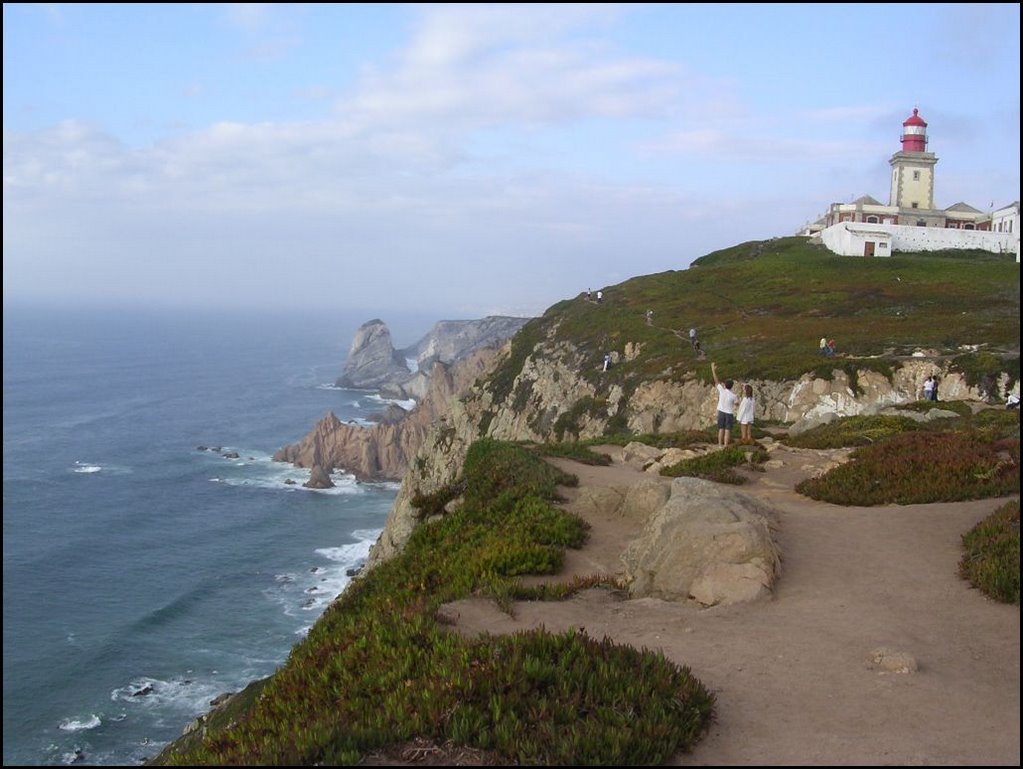
Images: Both of these are of the most western point in Europe -- Cabo da Roca. Doesn't the Atlantic Ocean look different than how we think of it? It is all a matter of viewpoint.

Labels: ,

Tuesday, November 21, 2006

Spiritual Boundary-Markers

In his book, The Life You've Always Wanted, Ortberg talks about boundary-marker spirituality. He defines these as "highly visible, relatively superficial practices ... whose purpose is to distinguish between those inside a group and those who are outside."

I carry around with me three employee ID badges. I'll not go into the reason that I have three - suffice it to say that it is necessary. All three of them are different employers, and depending on where I am during the day, I'll wear one or another of them. They are superficial - just a piece of plastic that says nothing about the quality of the work that I do. They are highly visible (when I choose for them to be). They distinguish me as an "insider" – a member of the group – and make me different from "outsiders" who don't have my special piece of plastic. They are boundary-markers.

While are spiritual boundary-markers may not be as obvious as my IDs are, we still have them. We use them to help us to identify who "belongs" in our church, and who does not. I have thinking about this concept, and wondered if I could come up with a list of the ones that I have seen (in my church, and in other churches). Keep in mind -- these boundary-markers are artificial and damaging to the Body of Christ.

My list (What would you add?):
  • It's sad to say, but the first one that came to my mind was money, and all of the "accessory" identifiers that come with it - career (and the status it carries), employment (as in employed or not), salary, as well as what the money will buy.
  • What someone wears can often be a boundary-marker, in at least two ways. First, the quality of the clothing can send out messages to those who are looking for that kind of identifier. In addition, and this might be only true of women, but skirt versus slacks in church can be a boundary-marker. I guess I should say that this IS only true for women.
  • A person's history in the church can set them apart. How long have you been a member? Does it make a difference in the way you are seen in the church?
  • Education can be a boundary-marker.
  • Age – Do we ever make our youth or college aged members feel like less of a part of the church than they are? Are we keeping them apart from "real" membership because of their age? Do we do the same thing to older members?
  • I'm not sure that I see this one in my church, but I imagine in some places doctrinal beliefs become a litmus test for membership. Believe the way that the church insists that you believe, or find another place to be a member.
  • Gender can be a boundary-marker. It can be used to limit a person's participation in the life of the church or to define it.
  • Sexual orientation – We have institutionalized sexual orientation as a boundary-marker in our churches.
  • Race – We don't talk about it much, but for some people, race is a boundary-marker.
  • And then, I must mention, or one of my "regular" readers will bring it up – clapping. Clapping might be a perfect illustration of a spiritual boundary-marker. Some people use it to judge the spiritual depth of a church member. "If he were really worshipping, if he knew that the music was an offering, he wouldn’t be clapping!"
What did Jesus use? Ortberg says, "Jesus consistently focused on people’s center: Are they oriented and moving toward the center of spiritual live (love of God and people), or are they moving away from it."

Speaking of backwards (yesterday's post), "This was the great irony of his (Jesus') day: The 'righteous' were more damaged by their righteousness than the sinners were by their sin."

Image: Sunrise this morning at the VA.

Labels:

Monday, November 20, 2006

It's backwards

As he speaks about transformation, John Ortberg says:

When morphing happens, I don't just do the things Jesus would have done; I find myself wanting to do them. They appeal to me. They make sense. I don't just go around trying to do them; I become the right sort of person.
I'm wondering this evening what that would look like.

After class last week, and thinking about the Beatitudes as being "backwards" from what we would logically except from life, I think that living as a "morphed" person, would be to experience life backwards from what we would expect.
  • A friend sent me a quote today by Saint Teresa of Avila -- "Our body has this defect that, the more it is provided care and comforts, the more needs and desires it finds." A life lived as Jesus would have lived would turn this quote backwards to read, "On body is designed such that the more care and comforts it is provided, the more we want to care and comfort other people."
  • I wrote yesterday about forgiveness, and the idea that the grace of the act is felt most often by the one forgiving -- sometimes not even noticed by the forgiven. Unlike what society says, the forgiven doesn't need to earn the act.
  • Serve a meal, make a donation, read to a child -- who is blessed? Certainly the one who receives the grace of the action, but just as much the one who acts for God. Do God's work, and know this to be true.
  • When we share gratitude, the receiver of the thank you is blessed. More than that, though, being gracious and full of thanksgiving is transforming -- it makes us realize how much we have to be thankful for.
  • Write a note to someone, pointing out God's work in his/her life, and learn how to recognize God walking among us.

It's all backwards. Our expectations -- at least those based in what society thinks -- are turned upside down when we morph. We learn to give grace, and we find that the more we give it away, the more we experience it. It's illogical. It's backwards.

Labels:

Friday, November 17, 2006

The Lord Remembers Us

Now, with God’s help, I shall become myself (Soren Kierkegaard)

You may notice that I’ve added a new book to the side bar – The Life You’ve Always Wanted by John Ortberg. Expect to hear a lot from this book in the coming weeks. I’ve read one chapter, and I’m liking it a lot!

The first chapter is called “And We Shall Morph Indeed: The Hope of Transformation.” I want to consider some of the writing in this chapter in the light of one of this week’s lectionary readings – 1 Samuel 1:4-20 and with a reflection back to the Beatitudes (once again).

The lectionary reading is about Hannah, Samuel’s mother. She was, as the Old Testament phrases it, barren. She desperately wanted a child. Eli sees her praying in the temple, and after a few mis-starts, tells her to “Go in peace; the God of Israel grant the petition you have made to him.” What impressed me is that she DID go in peace. She was “sad no longer.” That, to me, is a testament to her faith.

And the “Lord remembered her.” She conceived and bore a son, Samuel.

And the Lord remembered her. Hold that thought.

Think now about transformation. An Ortberg quote, “I am called to be the person God had in mind when he originally designed me.” We are poiema – God’s work of art. And one more from Ortberg, as if God is speaking, “You are what you are – but that’s not all that you are. You are what you are, but you are not yet what you will be. I will be with you.”

And the Lord remembers us.

Transformation. We have an innate desire to be transformed. We search for it, although sometimes in the wrong places. God is supremely, ultimately concerned that we BE transformed, so much so that he is willing to make it happen. So much so that he sent his son to accomplish it. So much so that he will take action so that we are changed – formed into what he designed us to be in the first place. Changed into who we really are. Changed so that we “become ourselves.”

The Good News as Jesus preached it is that now it is possible for ordinary men and women to live in the presence and under the power of God. The good news as Jesus preached it is not about the minimal entrance requirements for getting into heaven when you die. It is about the glorious redemption of human life –your life. It’s morphing time.(p 25)
And maybe, perhaps, that is the promise of the Beatitudes. Jesus is telling us of future hope – what the kingdom of God will be like in its completeness. More than that, though, he’s describing transformation. In our brokenness, in our barrenness, God breaks through. He will transform us into the creations he imagined us to be – that he designed us to be. It is all about a “glorious redemption of human life” today. Now. Jesus is saying, I think, “Fear not. There is hope in the future – I have seen it. But fear not, there is hope now!” Why?

Because the Lord remembers us.

Labels: